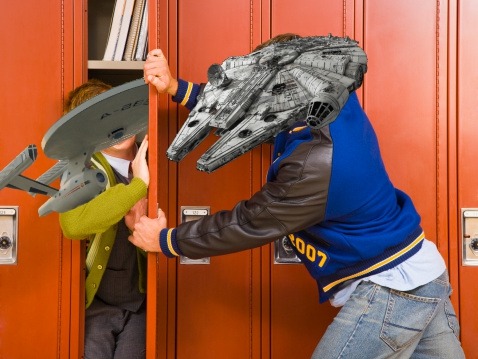
“the millenium falcon would wipe out the enterprise in seconds” lmao the enterprise is just an innocent science class floating thru space…. all they wanna do is look at some rocks… kiss an alien…. find some space plants….. why would you fight that its not a battleship theyre just nerds…… leave them olone
“The Galaxy-class Enterprise is armed with twelve Type X phaser arrays and three photon torpedo launchers, each capable of firing ten torpedoes at a time. The ship also has a high-capacity shield grid and, according to dialogue in the Next Generation episode “Conundrum” at least 250 photon torpedoes.”
it wouldn’t even be a fight tbh
also who is saying that the falcon could take anyone in a fight bc like? the whole thing the falcon is really good at is running away????? its a smuggler ship theyre good at being sneaky and fast
Also the 1701-D Enterprise is a combination warship and scientific exploration vessel (with the capability to separate its civilian portion if entering into battle) with a population of around 1000 crew and civilians onboard, while the Falcon is a flying two-bedroom college apartment that barely fights off one-person starfighters.
You know what? Okay. You ask a question, you’re going to damn well get a serious answer. You want to learn about spider farts, punk? You’re going to learn. You’re going to learn a lot more than you bargained for.
Arthropods obviously have very different digestive systems than vertebrates do, and spider digestive systems are unique even for arthropods. All but one species of spider are strictly predatory, and they take advantage of this diet by actually performing most of their digestion outside the body. Their formidable-looking fangs act like hypodermic needles to inject venom that immobilizes their prey. They then spit a cocktail of enzymes into the holes their fangs have created with their mouths (the venom and digestive enzymes are produced in different parts of the spider’s body!). These enzymes act like the ones in our saliva and stomach: they begin to break down the meat. It just happens to still be on the inside of the prey’s skin.
Some spider species, rather than keep everything neatly contained, just tear their prey apart and spit the enzymes onto the pieces. To each his own.
Once the prey’s insides have become a pre-digested slurry (and yeah, the prey is usually dead by this point), the spider slurps it up. This is actually a part of a larger process of spitting and slurping until everything is sufficiently broken down; hairs around the spider’s mouth block particles that are too large from being ingested. This is because the spider’s internal digestive system is shit and can’t handle anything but a liquid diet.
The spider’s stomach is actually a specialized sucking organ (called, appropriately, a ‘sucking stomach’) that flexes in order to facilitate all that slurping and spitting. It’s basically a muscular pump.
The spider digestive tract up to the sucking stomach is actually lined with cuticle- the analogue to our external skin. If having regular skin growing through your mouth and down to your stomach sounds odd, at least you don’t have to shed yours in one large piece. When spiders shed their exoskeletons, they actually have to shed the interior of their sucking stomach, too, and they pull this cuticle out through their brains. You cannot make this shit up.
While spiders don’t have much in the way of internal digestion hardware, they do have excellent storage units. These would be the caeca, located in the midgut past the sucking stomach. Since the spider doesn’t have space taken up by digestive organs, the caeca have a lot more room and even extend down some pairs of legs and even up towards the eyes in some species. Some species can even expand their caeca thanks to their soft abdominal cuticles- most arthropods have hardened exoskeletons and would explode if their organs expanded. So now you know why spider species are soft compared to other arthropods!
This storage capacity means that spiders can generally go a long time without eating, and when they do strike a big windfall, they can store much more than other arthropods could.
So now you know all about spider digestion- except for the end part. Even spiders have to poop. As you can see on the above diagram, they have an anus. Once the spider has extracted all it can get from its prey, the remains move from the caeca to the stercoral sac, which does what our colon does: it compacts and dehydrates everything into poop. And then the spider poops.
Spider poop is actually rather similar to bird poop- it’s usually whitish and semiliquid. This is due to the fact that it is full of concentrated uric acid. (Those of you familiar with the study of poop in all its forms will infer from this that spiders do not, in fact, pee.)
Spider poop, ladies and gentlemen.
Back to the original question: do spiders fart? And how will all that information about the spider’s digestive system (while quite fascinating) help you understand it? The answers are maybe and it really won’t. We fart because the bacteria in our colons produce air during the fermentation of our food. The actual smell comes from volatile sulfur compounds, including hydrogen sulfide, which make up less than one percent of the released gas. So 99% of the gas released when you fart doesn’t smell.
Spiders, too, have bacteria involved in fermentation in their stercoral sac, though they are very different bacteria than ours. But theoretically, that means that gas is probably produced as a byproduct of that fermentation. Though I don’t know of any recordings of spider farts out there.
I hope that answers your goddamn question, spider fart anon.




 EY FATTY BOOM BOOM