The “I am a piece of shit and nobody will ever love me” factoid is actually a statistical error. You are actually are fantastic and infinitely worthy of people’s company. That person you used to care about, who taught you to hate yourself by abandoning you, is an outlier and should not have been counted
my gf is german and she just forgot the word for slug so she asked me “how do you call snails without homes”
The German word for slug is Nacktschnecke, which means naked snail.
NOW ITS EVEN BETTER
And better still when you look at Nacktschnecke and realize that it preserves an old English usage that has been pretty much completely forgotten in our language over the last few centuries.
Once upon a time, more or less between the 1300s and the 1600s, the word “naked” was only very rarely an adjective (and essentially passive in nature). It was the past tense form of the active verb “nake”. To nake something was to strip it bare, divest it of some covering, reveal it, unsheathe it. “Naked” would have been pronounced as a single-syllable word, not always two syllables as we pronounce it now in English.
“Nake” turns up first in Old English / Anglo-Saxon (benacian) in the 1100s or thereabouts and becomes popular in the three or four centuries that follow. Then slowly the past-tense-adjectival form “naked” becomes more frequent and the verb form starts falling out of use, until the last we hear of it in active usage is around the 1600s. Nake’s last OED citation, in 1888, in a poetic work, is plainly meant as an archaic / obsolete usage: “He naked his sword, and swure he’d thole’t nae longer.”
So anyway. The German word for slug preserves the “nackt-” root, and tells us obliquely that not only is the poor slug shell-less, but that somebody came along and stripped that shell off and left the beastie unclothed and houseless against the cold harsh world.
A whole sad little story in one word. Poor wee sluggie.

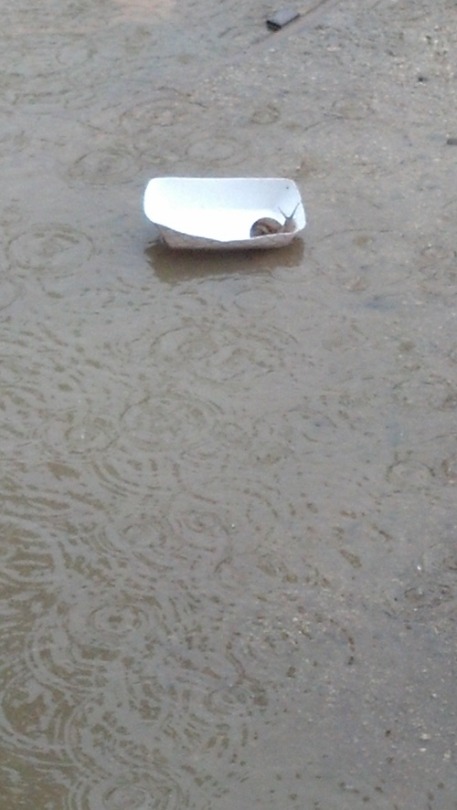
 EY FATTY BOOM BOOM