[Chevalière d’Éon, left, dueling with Saint Georges, right. Her sword can be seen striking her opponent.]
Chevalière d’Éon (born 1728) was assigned male at birth. She presented as a man for forty-nine years, and as a woman for thirty-three years. d’Eon held a variety of professions during her life including being a spy, a dragoon captain, and an author. When d’Éon demanded that the French government recognize her as female King Louis XVI and his court granted her request.
d’Éon was an avid fencer. She dueled throughout her life. For a time d’Éon toured England with another female fencer, actress and friend Mrs. Bateman, and made fencing her primary means of income. During 1787 the Prince of Wales arranged a match between d’Éon and Monsieur de Saint George, a master fencer acquainted with d’Éon, at Carlton House in London. While d’Éon did not win this match she did show off her skill by striking Saint George with a “coup de temps”, meaning she managed to hit Saint George during the preparation of his attack.
[above: 17th century illustration of the Tuileries Garden, a popular location for cruising]
“The general French perception in the 18th century was that aristocratic persons commonly succumbed to what was known as le beau vice [intimate relations between the same sex]. The police, however, increased their attempts to suppress homosexuality in the general population, including through entrapment and police harassment. Yet a gay subculture still managed a palpable, though marginal, existence. There were gay taverns in Paris, as well as known places for cruising, such as Pont Neuf and the Tuileries gardens. It is likely that this era’s move away from the death penalty for sodomy helped in the preservation of this subculture.”
— Brent L. Pickett, Historical Dictionary of Homosexuality. Emphasis added.
The hilarious thing about that medieval bestiary thing that’s ALL OVER MY DASH is that real medieval beliefs about animals were like ten times weirder than anything joked about in it.
Like, mice were believed to be clods of dirt that grew legs and a tail.
Worms were also believed to spontaneously generate from dead bodies. No reproduction needed, they just happened.
Bees were a kind of bird, and came out of livestock (oxen specifically.)
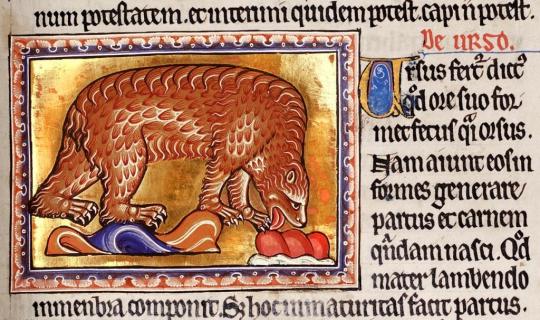
Bears were believed to be born shapeless, and had to be “licked into shape” by their mother’s tongue. (Yes, that is exactly where that phrase came from.)
Goat blood was believed to be hot enough to dissolve diamond, even though they had enough goats to disprove this.
Pelicans, supposedly, had terrible tempers and would beat their own young to death, then grieve so intensely that they’d wound themselves and their blood would revive the dead babies.
Seriously, this shit is wild. Look it up. It’s worth your time.
(I’m sorry for hijacking your post, OP, but I got really excited about this and I couldn’t help myself.)
Medieval bestiaries are super fucking weird, there is really no getting around it. I mean, the descriptions above are testimony of that. Let’s take a closer look at the Aberdeen Bestiary (England, c. 1200):
Here is an image of a bear licking her formless cubs “into shape”. The author of the manuscript describes the cubs as “tiny lumps of flesh, white in colour, with no eyes” who regain their shape from the licking of the mother and from cuddling (!). Also, bears apparently heal themselves by eating ants. The more you know.
Dogs get a very long description in the manuscript. Most importantly though, puppies are said to cure “inner wounds”!
Bees, who were in fact considered a kind of bird, are said to have a model society, ruled by a king (which they elected, mind you, this is a bee democracy. a communist bee democracy. wait what?) and possessing multiple armies. They are indeed also born from the corpses of oxen. If you feel like “producing” bees yourself, you can beat calves to death and wait until worms form in their blood. These worms will later become bees. Why not, right?
Aside from “real” animals, bestiaries were often also filled with imaginary ones. (some of these were inspired by classical mythology, such as the Minotaur, Chimera and Cereberus) Examples include:
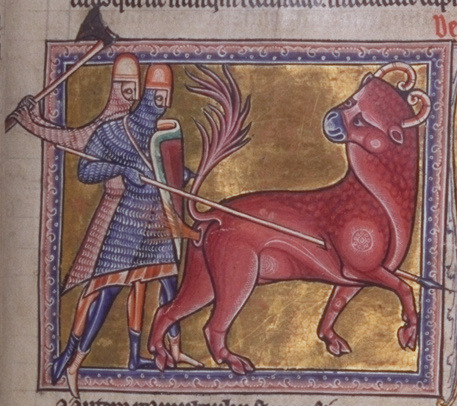
The Bonnacon, an Asian beast resembling a bull but with horns that curl inwards and the mane of a lion. Don’t chase this bastard, because he will poop dung that burns like fire to defend himself. (also it looks as though it has a tattoo on its upper arm?)
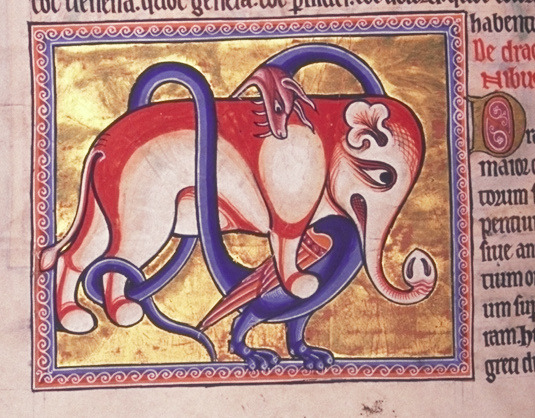
The Dragon, here fighting its mortal enemy: an elephant. Because obviously.
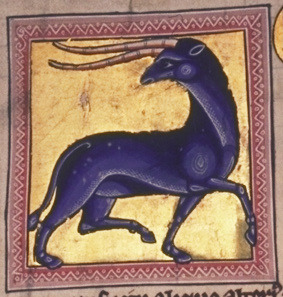
And lastly, meet the Yale! A black horse-like creature with two “unusually long” horns on top of its head, that are adjustable. According to the manuscript, they “move as the needs of fighting require. The yale advances one of them as it fights, folding the other back, so that if the tip of the first is damaged by a blow, it is replaced by the point of the second.” A+ on practicality there.
Bear in mind that in medieval times, nothing happened without a reason and things certainly didn’t get written down without a specific goal. Since most scribes and intellectuals in the (early) middle ages were members of the clergy, the bestiaries make slightly more sense if we remember the moralizing and educating function they had. Allegories and metaphors were basically medieval fetishes and the animal world was a lovely way to teach people about the Bible and about morals.
Slightly more sense that is, overall they’re still WEIRD AS FUCK.
i’ll never not be amused by the fact that there’s a species of snake who tries to scare off potential predators by ‘farting defensively’
it’s called the chihuahuan hook nosed snake and back in 2000 there was an experiment done by a morphologist at a college to study the snake’s defensive farts and according to his research there were some snakes who farted so energetically that theylifted themselves off the ground
next time you feel uncertain about snakes, just think about the chihuahuan hook nosed snake and it’s almighty tooty booty
Brazil, June 26th 2015 – Public debate between one of the country’s most homophobic pastors / ministers (left) and the president of the LGBT Brazilian Association (right). This picture says a lot.

 EY FATTY BOOM BOOM