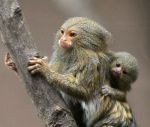
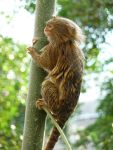

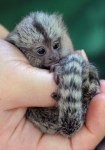
Pygmy marmoset (Cebuella pygmaea)
The pygmy marmoset is a small New World monkey native to rainforests of the western Amazon Basin in South America. It is notable for being the smallest monkey and one of the smallest primates in the world at just over 100 grams, with a head-body length ranging from 117-152 mm and a tail of 172-229 mm. It is generally found in evergreen and river edge forests. About 83% of the pygmy marmoset population lives in stable troops of two to nine individuals, including a dominant male, a breeding female, and
up to four successive litters of offspring. The modal size of a standard
stable troop would be 6 individuals. Members of the group communicate using a complex system including vocal, chemical, and visual signals. These monkeys may also
make visual displays when threatened or to show dominance. The female gives birth to twins twice a year and the parental care is shared between the group. There are two subspecies. This monkey has a specialized diet of tree gum. It gnaws holes in the bark of appropriate trees and vines with its
specialized dentition to elicit the production of gum. When the sap
puddles up in the hole, it laps it up with its tongue. It also lies in
wait for insects, especially butterflies, which are attracted to the sap
holes. It supplements its diet with nectar and fruit.photo credits: Brian.gratwicke, Don Faulkner, Karra Rothery, animalspot
When I was guiding at Sacha Lodge in Ecuador, we had a family of them that lived near the lodge. They would always come to a Papaya del Monte tree where they maintained little sap wells. They’d climb all over the trunk licking the sap from the little holes. It was adorable :3

Tag: nice
Penguins: clumsy but adorable.
i never wanted this to end
oh my god those are ROCKS the penguins are falling on ROCKS are you OKAY PENGUINS do you need WINGPADS OR SOME OTHER KIND OF SHOCK ABSORBING PROTECTIVE BODY GEAR
I just laughed harder and harder.
never fear: penguins are fat blubbery creatures that just bounce off. they’re good.

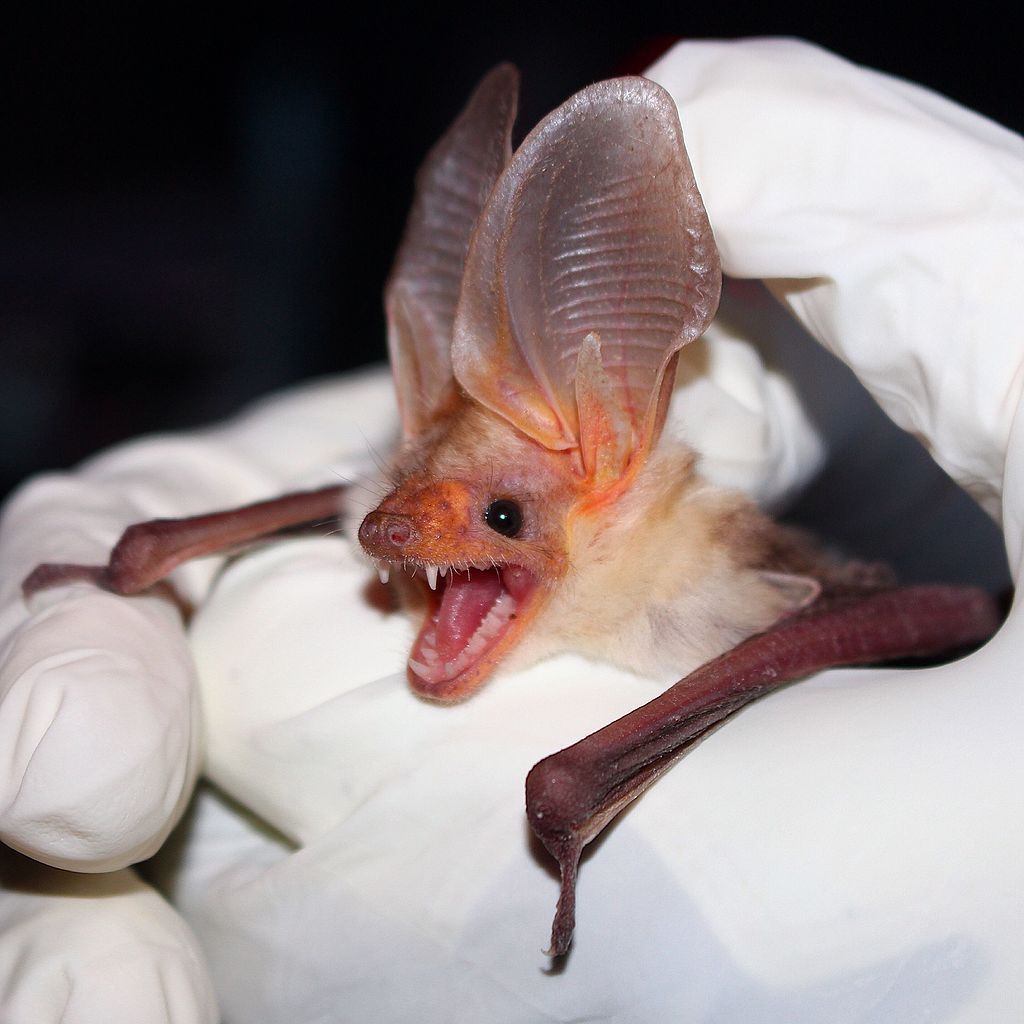
A Pallid Bat (Antrozous pallidus) trapped by mist-net , and released, as part of a zoological survey by Sacramento City College in the Mojave Desert of California.
“RELEASE ME HUMAN! I’LL KILL YOU, I’LL KILL YOU ALLLLL!!!”
photograph by Connor Long
i have always wondered whyanimals like dogs and cats have litters at a time while humans tend to have a single children? sorry if this is a stupid question
It is not at all a stupid question- it’s a question a lot of biologists have devoted a lot of time examining, after all, since it says a lot about an animal’s lifestyle.
The amount of offspring an animal has depends on several factors, but the main one is how many of them, on average, will survive to adulthood. For an animal like a mouse, for instance, which is basically food on four legs, it makes sense to have LOTS of babies. For an animal with tiny, tasty free-swimming larvae like a crab, it makes sense to have a HORDE of tiny babies.
For an animal like you- like a human- while it certainly isn’t the case that all human babies are bound to survive to adulthood, there’s a much higher chance of it. So instead of investing energy into having MANY babies, we invest energy into making our ONE baby be very big and strong. We can afford to do that if there’s less of a chance of it dying. If a mama mouse put all her time and effort into raising one pinky, it could very easily amount to nothing if pinky gets gobbled by a snake.
There is actually a name for these two strategies (and I should also mention that it is a spectrum, and those are the extreme ends)- r and K strategies. “r-selected” refers to organisms who have lots of babies, while “K-selected” refers to organisms who throw a lot of investment into only a couple at a time.
This graph shows what i mean. The y-axis is how many individuals of a species survive, and the x-axis is increasing age. So you can see that the amount of surviving oysters decreases sharply with age, versus the amount of humans.
r-selected organisms also have a number of other common traits, such as a short lifespan, small body size, and rapid sexual maturity. K-selected organisms are often the opposite, being large, slow-aging, and long lived. But these are not exclusive by any means; you can have very long lived animals like sea turtles, for instance, still producing great masses of eggs simply because the infant mortality is so high. Or you can have a tiny mouse-sized bat that lives 20 years to the mouse’s 2 and has one baby each season.
Basically, a lot of evolutionary factors go into an organism’s litter size.
Figures taken from these two pages, which both talk in more detail about K and r selection.
this iS REALLY FUCKING FUNNY JUST WAIT FOR IT TO GET GOING
That’s one hell of a Rube Goldberg machine.
all good rube goldberg machines contain a live animal