MPs vote in favour of ‘three-person embryo’ law
MPs have voted in favour of making Britain the first country in the world to permit IVF babies to be created using biological material from three different people to help prevent serious genetic diseases.
In a historic debate, the House of Commons voted by 382 to 128 – a
majority of 254 – to allow mitochondrial donation through a
controversial amendment to the 2008 Human Fertilisation and Embryology
Act. They approved the regulation in spite of some critics warning it
was a step towards creating “three-parent” designer babies. The regulations will now have to be approved in the House of Lords, where they are likely to be passed.Mitochondrial diseases are caused by genetic faults in the DNA of tiny structures that provide power for the body’s cells. The DNA is held
separately to the 20,000 genes that influence a person’s identity, such
as their looks and personality. Because mothers alone pass mitochondria
on to children, the diseases are only passed down the maternal line.The “three parent” IVF therapy, which could help to eliminate certain
incurable genetic diseases, involves swapping a fraction of a mother’s
DNA with that from an anonymous female donor. Around 100 children
each year are affected by genetic defects in the mitochondria and in
around 10 cases the defects cause severe illnesses such as liver
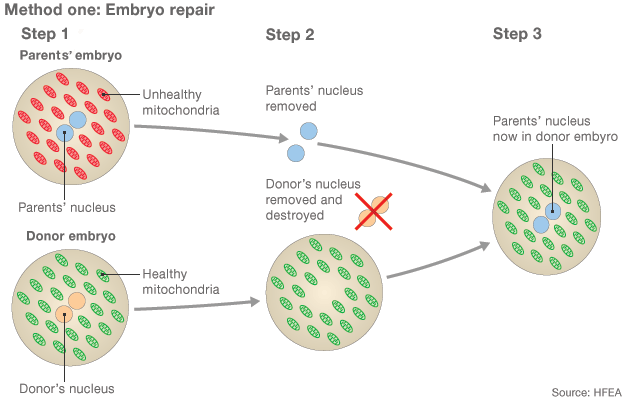
failure, muscle wasting, blindness and brain damage.1) Two eggs are fertilised with sperm, formulating an bud from a dictated relatives and another from a donors 2) The pronuclei, that
enclose genetic information, are private from both embryos though
usually a parents’ are kept 3) A healthy bud is combined by adding a
parents’ pronuclei to a donor embryo, that is finally ingrained into a
womb
 EY FATTY BOOM BOOM