Legends say that hummingbirds float free of time, carrying our hopes
for love, joy and celebration. Like a hummingbird, we aspire to hover
and savor each moment as it passes; embrace all that life has to offer
and to celebrate the joy of every day. The hummingbird’s delicate
grace reminds us that life is rich, beauty is everywhere, every
personal connection has meaning and that laughter is life’s sweetest
creation. –Papyrus
I…Ah…hmm.
Look, it’s a great photo. The photographer kicked butt. They should be very proud of this photo.
But hummingbirds are not carrying your hopes for joy around. I am sorry. Have you met hummingbirds? Hummingbirds believe strongly that they should be eighteen feet tall and have flamethrowers. They are a half ton of pugnacious wrapped up in a half ounce of feathers. Given the choice, hummingbirds would fly around with “Ride of the Valkyries” blasting out of tiny speakers on their wings, putting the eyes out of their enemies.
They do not fear humans, but if they learn that humans will provide feeders, they will become very demanding. They are fiercely territorial. They are…kind of jerks, actually.
Also, there are papers indicating that female hummingbirds engage in what can only be termed “nectar-based prostitution” where they trade sexual favors to males in return for access to particularly rich nectar sources.
If your hopes for love involve nectar and your hopes for joy involve crushing your foes, seeing them driven before you, hearing the lamentations of their nestlings, etc, then possibly the hummingbird may carry them around, otherwise…uh…have you considered vultures? Vultures are very pleasant, affectionate, and social birds. You should probably give them your hopes and dreams. They would be better at it.
Did I mention it’s a great photo?
VULTURES, NOW.
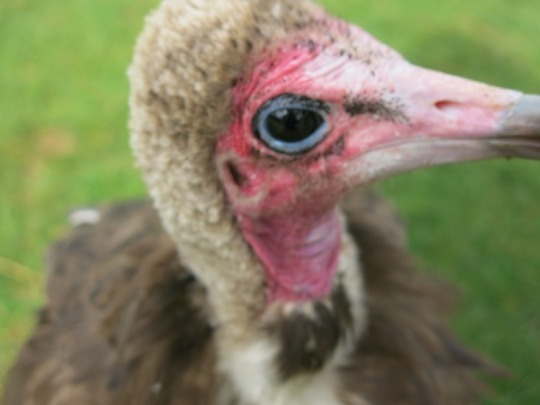
this is Jack.
Jack (full name: Jack Sparrow) lives at the Hawk Conservancy. (He’s missing some toes because he was rescued from Vulture Smugglers.)
When you interact with Jack, you can tell he’s at about the level of … something between a ferret and a dog. Funny short little attention span, and a weird face to look at, but a human reads him as curious, friendly and interested in people.
When you meet a working vulture, you realize that they are definitely a wild predatory animal and very instinctive, but with a
consciousness that extends to interest in their surroundings; like, he’s
very much focused on THE SNACK, but before and after the SNACKTIME he
also wants to have a chat about your day and look at your face and peer into your camera and ask to look at the pictures you took and then say “hey now take one where I’m doing duckface” and you’re like “ok Jack go ahead”
Contrast with owls, which are typically pretty, but which are basically as interactive as a pop-up ad. They exist to land on things and eat them. They are not complicated. Vultures are hey-whatcha-doin. They’re yeah I’m a psychopomp but my real hobby is DJ-ing. They’d like to couchsurf next time they’re in town. You’d let them.
I would give Jack my dreams to carry. He would hold them well, in his big black lovely inky eyes, in his broken gentle feet.
On 12 June 1783 Robespierre wrote a letter to his friend Buissart and Buissart’s wife containing a description of a brief vacation he was taking to visit family relatives nearby. Sure enough, he describes his entry into the neighboring town:
This instance was mentioned in a Robespierre biography by Jean Matrat, although I don’t have the book on-hand to quote it directly.
So basically, Robespierre was going through the countryside in a carriage, and he had this idea that the people living there were jolly and welcoming.
Robespierre got really excited, right, and so upon seeing some people outside of his carriage window, he poked his head out and shouted “hello!”, waving to them like a lunatic.
Of course, the bewildered citizens did not return his strange gesture, and this made Robespierre rather disgruntled. Apparently, it ruined his day.
I believe that this is based off of a letter that he wrote to someone while he was travelling. Augustin, perhaps? I’m really not sure. But I laugh every time I read about it. Poor Robey.
It was five in the morning when we left; our chariot issued from the gates of the town [Arras] precisely at the moment that the sun’s chariot sprang from the ocean’s bosom. It was decorated with a cloth of dazzling whiteness, a piece of which floated in the air, the sport of zephyrs; it was thus we passed before the dawn-risen gatekeepers. You may be sure that I did not fail to turn my eyes upon them; I wished to see whether these Arguses of the farm would belie their ancient reputation for civility; I dared to hope that I might exceed them in politeness, if that were possible. I leant out of the carriage; I removed the new hat which covered my head; I saluted them with a gracious smile; I counted on a fitting return. Would you believe it, those gate- keepers, immobile like wayside gods at the door of their hut, gazed upon me with a fixed stare, and did not return my bow! My self-love has always been excessive; this look of contempt wounded me to the quick; I was in an abominable temper for the rest of the day.
This zany tone holds throughout, eventually spiraling down into that infamous “fruit tart” poem that tumblr loves so much.
Regarding Robespierre’s personal manner, the butt of the letter’s joke is always Robespierre himself, who he caricaturizes as vain, attention seeking, and overdramatic. The common sneer, that Robespierre couldn’t laugh at himself, that Robespierre never joked, etc., is contradicted — even if we don’t find it funny (and I do) it’s nonetheless clear that Robespierre is jesting.
With that said, certain historians – I think G. Lenotre, for example, but feel free to correct me if I’m getting him flopped with someone else – argue that since Robespierre Never Joked, this letter must be read in flat seriousness. This loop is fascinating: Robespierre Never Joked. Well, I mean, we have this letter here where he seems to be joking, but since I just said he never joked, obviously this letter must be a deadpan reflection of the events Robespierre portrays. It’s the epitome of twisting your evidence to suit your theory and —- and I got WAY off track here.
Yes, Robespierre once Got Excited about being in a new town, waved like a crazy person, and was rebuffed because it’s 5 A.M dammit, no one is in the mood for this shit .
This is actually one of my favorite Robespierre anecdotes, too.
writers of the world: please stop using epithets in your writing, trust me “the blonde army doctor”, “the curly haired detective”, “the blue-eyed man” etc. do not sound as good in writing as they may sound in your head
instead, use the characters’ names, they’re there for a reason and it’ll make your writing much more crisp, tight, to the point, and still entertaining
Names, along with common words like “said” and “asked”, become invisible. The more invisible your words, the deeper your reader will fall into your writing, to the point where the reader will forget that there are words at all and just become part of the story.
When your words aren’t invisible, there’s the unfortunate potential that people will turn them into a drinking game instead of reading the story.
Just about the only time that epithets work instead of using a name is when the POV character doesn’t know the other character, and so the physical description is pretty much all the POV character has to go on. You don’t think of people you know as “the tall man” or “the blonde woman”. Your POV character shouldn’t, either.
Yo I actually wanted to make this post a while back and I think a lot of this stems from when you have two characters who use the same pronouns interacting (which happens in fanfic). There’s this fear that the reader will confuse who the characters are referring to, so that’s why epithets are used. Instead of using epithets, use syntax, which is word order, and carry your subject through multiple sentences and actions. So, Imma teach you how to do this under the cut. (It’s a bit of a grammar lesson tbh)
“Restraint, control and and propriety were vital if society was not to blow up in their face.”
—Roy Porter, England in the Eighteenth Century
It is important to stress that the society Jane Austen was writing about — and of which she was a loyal and critical member — was one which was essentially based on landed interests, the sacredness of property. At least since John Locke affirmed that “Government has no other end but the preservation of property” (in The Second Treatise of Government, 1690), the “rights of property” were continually stressed until they no longer appeared as the arbitrary and repressive ideology of the ruling propertied class but rather as a law of nature – “that law of property, which nature herself has written upon the hearts of mankind” (William Blackstone, 1793). Throughout the eighteenth century the general order and stability of society and the “rights of property” were not only inseparably linked: they became regarded as identical. […]
In an essay discussing “Property, Authority, and the Criminal Law” in the eighteenth century (in Albion’s Fatal Tree) Douglas Hay examines the various ways in which the populace was persuaded, or forced, to assent to the “rule of property”. […] Clearly terror was not the most important — or successful — way of maintaining the structure of authority which arose from property and protected its interests. The bonds of “obedience and deference” had to be maintained and perpetuated in other, subtler ways. What could never be exacted by legalised brutality might be won by a paternalistic mode of behaviour on the part of the landed class, by graciousness, justice, generosity, mercy. In this way, ideally at least, social control in the eighteenth century might appear as a “spontaneous, uncalculated and peaceful relationship of gratitude and gifts” and the whole system “a self-adjusting one of shared moral values, values which are not contrived but autonomous”. To maintain that this ideal was in fact how society worked and was bonded together necessarily involved a great deal of mystification, varying degrees of self-deception and inter-colluding habits of seeing — or not seeing — and selectively distorting and censoring aspects and conditions of society as they actually were. And of course the façade if harmonious relationships between the ruling propertied class and the populace was often a very thin and transparent one.
There was social order and stability, but it was always precarious and insecure. Just as there were regular hangings, there were frequent if often ineffectual riots. But above all of course there was the frightening example of the French Revolution. The Gordon riots of 1795 in London indicated the existence of plenty of easily-inflammable latent violence and discontent. (In a riot in October 1795, a window of the royal coach was broken, to the accompaniment of cries of “No King!”) The dream of an unshakeable, “natural” social order composed of benevolent propertied authority and loyal deferential populace came to seem increasingly threatened, increasingly unreal (to Jane Austen among other people). It was impossible complacently to assert that anything like the French Revolution couldn’t happen here. It all too obviously could.
This is why, for one thing, there was an increasing emphasis on the importance of property, in maintaining social peace and order in late eighteenth-cetury England. (An example of this intensification of emphasis is the way in which Burke reversed Adam Smith’s assertion that property was dependent on social order and made social order dependent on property — thus further “naturalising” and prioritising property.) To this extent Jane Austen is in agreement with the dominant ideology: her proper heroes all have landed property and her heroines need a propertied man (Persuasion as always the significant exception).
But in addition, and equally important, there was a new emphasis on the need for good manner and morals among the propertied class. Since they did not rule by police and force but rather by system of deference and obedience, they had to be exemplary — in every sense. […] Property was a necessary, but not sufficient, basis for a stable and orderly society. Decorum, morality and good manners — in a word, “propriety” — were equally indispensable. The one without the other could prove helpless to prevent a possible revolution in society. […] For Jane Austen, to secure the proper relationship between property and propriety in her novels was thus not the wish-fulfilment of a genteel spinster but a matter of vital social — and political — importance. That is why it is in many ways irrelevant to argue whether she was a relatively mindless reactionary or an incipient Marxist. She did believe in the values of her society; but she saw that those values had to be authentically embodied and enacted if that society was to survive — or deserve to survive. She indeed saw her society threatened, but mainly from the inside: by the failures and derelictions of those very figures who should be responsibly upholding, renewing and regenerating social order.
Bad manners were not simply a local and occasional embarassment to be laughed at: they could be syptoms of a dangerous sickness in her society which could ruin it from within — through neglect, transgression and omission rather than by mobs and the guillotine. That there are so few of her characters who seem fully qualified to act as the necessary maintainers of the society of her novels is a measure of her concern and incipent pessimism, a pessimism actualised and visible in her last work.
— Tony Tanner, Jane Austen, Macmillan, 1986, pp. 16-18
I just love pre death penalty Robespierre very much….
*sighs heavily* ughh
Yeah, so. There’s this thing called the skid theory, which, according to our good friend Albert Soboul, implies that 1789-1791 was all fine and dandy but 1792-1794 transformed the Revolution’s aims into that of a bloodthirsty dictatorship led by none other than Robespierre. Sounds pretty fatalist, right?
It’s a great filler piece, no doubt, in attempt to fabricate an explanation. But, to quote Soboul: “There was not a skid of the Revolution in 1792, but a will of the revolutionary bourgeoisie to maintain the cohesion of the Third Estate through an alliance with the popular masses, without whose support the gains of 1789 would have been forever compromised…
…Reintroducing into history the contingent and the irrational does not seem to constitute progress in the profession of a historian, but indeed retreat and almost a surrender” (271).
The thought of a “pre-death penalty” and “post-death penalty” Robespierre is therefore ridiculous. Robespierre shifted his views based on the demands of the time, as several politicians throughout history have in times of urgent crisis. As Soboul mentions, an alliance with the people was required, and certain Terror legislation reputed for its notoriety, such as the Law of 22 Prairial, were designed to prevent excess bloodshed and stop popular violence from flaring up.
So. Let’s eliminate the notion together that Robespierre suddenly turned into a bloodthirsty hell demon in 1792 when he voted for the death of Louis. Because guess what? The majority of the Convention voted the same way.
Have a wonderful day, everyone. 🙂
I agree with this but I also think that the views that Robespierre held in 1789 are not less valid than those in 1793 just because it was “a time of crisis”. And vice-versa. The fact that Robespierre accepted the death penalty from a determined moment onwards doesn’t make it any less exceptional that he was one of the only people to want the abolition before in a time that most people were in favour of the death penalty (Even supporters of Beccaria would think the death penalty was required in cases of treason and danger to civil and public life).
What I mean is while I do think that “pre-death penalty Robespierre” was the “good” Robespierre is a erroneous assertion because you can’t really pick and chose which Robespierre you like while analysing his thought and is also a lack of understanding of the development (Without the positivist connotation) of revolutionary thought (also the good and bad involves most of the times a simplistic judgement of the situation) I also think we shouldn’t take the opposite direction which is to believe that the views Robespierre held before 1792-93 are totally invalid and unimportant before the supposed “evolution” of his thought. What should matter is why he changed and what brought about that change and even to wonder how what he thought during 1789 or 1790 goes in line with what he thinks 2 years later.
there are a lot of philosophers out there, and they all need to get pummeled. here’s the chances that you’ll come out on top in no particular order.
Socrates Who wins: Socrates Look, there is a -100% chance that Socrates lands a KO, but that’s because he doesn’t need to. you come in spoiling for a fight and by the end of it you’re seriously debating whether you can truly claim to have ownership of your arms. It makes you want to fight him more and then you just get deeper into the spiral. don’t bother.
Plato Who wins: Plato Sorry, but his name literally means ‘burly guy.’ you’re not going to win this one.
Aristotle Who wins: You Ok actually I don’t know who wins here but Aristotle needs to be beaten up so badly. Please punch him. I’ll help.
Diogenes: Who wins: Diogenes I get why you want to fight him. I want to fight him. Everyone wants to fight him. don’t do it tho. His entire life is a series of him asking people to fight him and he still lived to one million years old. Don’t do it.
Epicurus Who wins: Epicurus Jesus don’t fight Epicurus. dude does NOT care. your punches will be like water off a ducks back.
Kant Who wins: Nobody I forget the argument I was going to make because I just looked him up and he looks like a weird adult baby.
you’ll win this one but why do you want to fight an adult baby. Avoid.
Voltaire Who wins: You sidenote: is there a single picture where Voltaire doesn’t look punchable?
honestly. anyway, look at the guy, he’s like 20 pounds. punch him.
Hume Who wins: Hume ‘In 1731, he was afflicted with a ravenous appetite and palpitations of the heart. After eating well for a time, he went from being “tall, lean and raw-bon’d” to being “sturdy, robust [and] healthful-like”’ HE GOT ILL AND IT ONLY MADE HIM STRONGER. AVOID.
Hegel Who wins: ??? I honestly don’t know but ughhhhhhh he’s so smuuuuuug. Do it. Beat up Hegel.
Kierkegaard Who wins: You Like, the entire Concept of Anxiety. there is no way you could lose this fight. go for it.
Spinoza Who wins: You But you won’t feel good about it. All this scrawny man wants to do is grind up some lenses and maybe watch some spiders making a web if its a wild day. Don’t fight Spinoza.
Descartes Who wins: Descartes Guy was a mercenary. He like, did fencing. Don’t fight Descartes.
Nietzsche Who wins: You Use his moustache as a pulley and kick him in the chest. When you knock him out whisper ‘human, all too human….’, and laugh.
John Stuart Mill
Who wins: You JSM is the proto weird atheist guy who corners you and insists on going on and on about Richard Dawkins. You could take him easy. Fight John Stuart Mill.
Schopenhauer Who wins: Schopenhauer He believed that the world is fundamentally unsatisfied and in search of satisfaction?? This man is DYING to punch somebody. Don’t do it.
How political cartoons and Revolutionary artwork contribute to vilifying Robespierre today:
i. Bringing Robespierre to the forefront.
Many engravings and paintings include titles, such as those above, attaching Robespierre’s name to the entire body of government or to the Revolution itself – “the regime of Robespierre”, “Robespierre’s government.” The numerous legislative bodies existing during the period are left out so as to deem Robespierre responsible for five years of political upheaval and, more specifically, for the Terror itself.
ii. Connotations of death.
The figure of death, depicted in the cartoon on the left, or in the piles of disembodied heads on the right, is shown to represent revolutionary excess. By attaching it to Robespierre’s name, even in a single image such as these, the effect comes across as though Robespierre was directly responsible for it. This also overemphasizes the “darkness” of the years 1793-94 (thus contributing to the skid theory mentioned by Albert Soboul in Understanding the French Revolution, a theory separating Robespierre into ‘the Robespierre of 1789-1791′, or the ‘good Robespierre,’ and ‘the Robespierre of 1792-1794′, the Robespierre who ‘tragically slid into fanaticism’). By romanticizing ‘darkness’, posthumous viewers are conditioned to despise the years of the Terror without question, viewing the period though a strictly moral (and, in our case, 21st century) lens, a lens devoid of context.
iii. Notions of anarchy.
Certain paintings, namely the one I show below, depict the Revolution as chaotic and hellish, demonizing specific revolutionaries. These depictions teach us to once again morally condemn the Revolution without context.
iv. The notion of blood and violence.
By romanticizing and emphasizing the bloodiness of the Terror and placing it in direct line of Robespierre, as though it were his single-handed creation, we are trained to automatically connect Robespierre with bloodshed. Works of literature can be notorious for this kind of portrayal (Charles Dickens, I’m looking at you).
v. Creating myths.
As not all works are visual, certain media, such as poetry, can be notorious for propagating myths about figures like Robespierre or even the Revolution itself. An example of a myth is the notion that Robespierre seduced women (a more Thermidorian myth, but still, to this day it contributes to detracting Robespierre), highlighted in Mehee de la Touche’s poem La queue de Robespierre:
Robespierre’s tail is most in fashion
To soothe and still the ladies’ passion
When his tail and his sharp blade
Penetrate some charming glade,
I hear a young virgin’s plea:
O how this knife stabs me!
This Robespierre of a tail
With blood will gorge and swell;
Squeeze it if you dare
Till pleasure wakes up there.
The murderer’s huge tail
Makes the whole world quail;
This tail bears a deep stain
Of pleasure, love, and pain.
Again, combined with sexualizing Robespierre, this poem emphasizes the notion of blood and violence.
vi. Portraying Robespierre as… *spins wheel* cold-hearted, bloodthirsty, tyrannical, emotionally detached, etc.
Both written and visual works contribute to this image. Many engravings or portraits depict Robespierre to be very stoic or stiff in posture; his facial features seem to sharpen in parallel with the artist’s dislike. There have also been mentions of his “green complexion,” dramatizing his appearance (or occasional leave of illness?) to make him appear inferior and an object worthy of hatred. An engraving goes as far as to depict Robespierre squeezing blood out of a heart; again, the sharp-and-stoic combination of facial features are present.
Antoine de Saint-Just also receives this frigid representation. A quote sums up the attitudes of these artists quite well:
“As to Robespierre himself, he was never a dictator, and there is no reliable evidence to suggest that it was his aim…men called him a dictator because they feared his moral inflexibility in one who had power.”
–William Doyle, The Oxford History of the French Revolution
vii. Attaching Robespierre to religious fanaticism.
As I mentioned in the use of the skid theory before, many historians, authors, and even artists equate Robespierre’s efforts in the Revolution to that of a religious crusade or religious fanaticism, emphasizing the Revolutionary calendar or the festival of the Supreme Being without placing it in context with political maneuvering or the circumstances under which Robespierre and his contemporaries were placed (especially their responsibility to help maintain public spirit). Many of the Terror’s excesses, such as the drownings (noyades) at Nantes committed by Jean-Baptiste Carrier and summary executions at Lyons committed by Jean-Marie Collot d’Herbois, 1) fail to mention the names of the deputies-on-mission actually involved in these atrocities and 2) instead slap Robespierre’s name on the label and make it appear as though he himself was party to abusing the Terror (when in fact he heavily condemned such abuses!). Robespierre is mistakenly labeled as an atheist as well, when in fact nothing could be less true, as Robespierre openly opposed the abuses of the dechristianization movement and publicly stated his belief in God, equating the harm of priests, clergy, and Christians (some of which was carried out in the aforementioned abuses of terror) on par with that of the Catholic church’s lack of religious tolerance in previous centuries. He also condemned atheism as “aristocratic.” That is not to say that Robespierre necessarily despised atheists either; he simply did not like that other revolutionaries were infringing on others’ rights to freedom of worship.
Robespierre is also frequently implicated in the notion that he himself created the Revolutionary calendar when in fact a man by the name of Gilbert Romme is known to have created it, and Fabre d’Eglantine to have named the months.
Robespierre Who wins: ??? The guy was, like, 5’2" and tiny. His glasses fall off as he’s attempting to deliver a roundhouse kick and he can’t see shit anymore, so you just leave him alone. Why are you trying to fight Robespierre, anyway? What are you getting out of this? You are reported to the Revolutionary Tribunal two days later.
Saint-Just Who wins: Saint-Just He isn’t called the Angel of Death for nothing. As well as having supreme stealth and agility, Saint-Just is known for his blindingly good looks, and you stop and stare at his gorgeous face just as he’s punching yours. You topple over and lie on the street for half an hour, his dazzling eyes ingrained in your memory.
Danton Who wins: Danton This guy is burly as fuck, and he will destroy you. But you should fight him anyway. Come on, do it. It needs to happen.
Marat Who wins: No one Marat’s just soaking in his bathtub, when suddenly, you burst through the door. Like what the fuck, why would you do that? He flicks disease-ridden bathwater at you. Just before you counterattack, Charlotte Corday stabs you from behind, runs over to Marat, and kills him too. She beat you to it, buddy. Better luck next time.
Camille Desmoulins Who wins: You Camille insists on talking about his day as you’re on your way to the Convention. He trips over his own foot and crashes into a lamp post. It’s no use, you think. There’s no point.
Hébert Who wins: Hébert He curses like no other, he has no boundaries. Everyone wants to punch him at this point. You try to, but it’s too late. He jumps onto a table and starts throwing things at you, screaming obscenities as you run away in terror. He jumps onto your back pins you to the ground in an instant. Don’t fuck with Hébert.
Couthon Who wins: No one Look, okay, if your life has gotten to the point where you want to fight Couthon, you need to prioritize more. He’s paralyzed and is holding a small dog. How dare you, you filthy monster
It just kills me when writers create franchises where like 95% of the speaking roles are male, then get morally offended that all of the popular ships are gay. It’s like, what did they expect?
I feel this is something that does often get overlooked in slash shipping, especially in articles that try to ‘explain’ the phenomena. No matter the show, movie or book, people are going to ship. When everyone is a dude and the well written relationships are all dudes, of course we’re gonna go for romance among the dudes because we have no other options.
Totally.
A lot of analyses propose that the overwhelming predominance of male/male ships over female/female and female/male ships in fandom reflects an unhealthy fetishisation of male homosexuality and a deep-seated self-hatred on the part of women in fandom. While it’s true that many fandoms certainly have issues gender-wise, that sort of analysis willfully overlooks a rather more obvious culprit.
Suppose, for the sake of argument, that we have a hypothetical media franchise with twelve recurring speaking roles, nine of which are male and three of which are female.
(Note that this is actually a bit better than average representaton-wise – female representation in popular media franchises is typicaly well below the 25% contemplated here.)
Assuming that any character can be shipped with any other without regard for age, gender, social position or prior relationship – and for simplicity excluding cloning, time travel and other “selfcest”-enabling scenarios – this yields the following (non-polyamorous) possibilities:
Possible F/F ships: 3 Possible F/M ships: 27 Possible M/M ships: 36
TOTAL POSSIBLE SHIPS: 66
Thus, assuming – again, for the sake of simplicity – that every possible ship is about equally likely to appeal to any given fan, we’d reasonably expect about (36/66) = 55% of all shipping-related media to feature M/M pairings. No particular prejudice in favour of male characters and/or against female characters is necessary for us to get there.
The point is this: before we can conclude that representation in shipping is being skewed by fan prejudice, we have to ask how skewed it would be even in the absence of any particular prejudice on the part of the fans. Or, to put it another way, we have to ask ourselves: are we criticising women in fandom – and let’s be honest here, this type of criticism is almost exclusively directed at women – for creating a representation problem, or are we merely criticising them for failing to correct an existing one?




 EY FATTY BOOM BOOM