I’m coming in late to this conversation because I wanted to take a lot of time to read and listen. I’ve watched the videos, listened to the news reports, read eyewitness accounts, and read responses by or spoken to zookeepers, exhibit designers, primatologists, attorneys, and dangerous animal response team members. Here is what I have for you: the incident at the Cincinnati Zoo was a tragedy. Once the child was in the moat, what had to happen could not have been prevented. Actions need to be taken on all sides to ensure that such a perfect storm of a bad situation can never happen again. I am glad the child is alive and I grieve with the zoo staff for the loss of their beloved and rare companion. I do not believe in continuing to point fingers and lay blame – those who deserve it are well aware at this point, and while it is natural and human to seek vengeance and justice it does no good to protect future children and future gorillas. So, with that said, let’s talk about what happened.
On the event:
Here is the best sequence of events I can piece together from eye-witness reports. The boy involved had mentioned he wanted to get into the water with the gorillas. His mother said no, but was also responsible for several other young children at the time. Another woman present at the scene noticed the boy after he had “flopped through over the fence” according to her social media post, and was crawling so quickly through the bushes towards the moat that the woman and her husband weren’t able to grab him. The mom, who had been taking a photo when her son left her side, was looking for him and was heard calling for him around when he went over the edge of the moat.
The Dangerous Animal Response Team (DART) – a fixture of any AZA accredited facility’s plan for any situation involving a dangerous animal – attempted to coax Harambe out of the exhibit. All three female gorillas on exhibit shifted out easily, but Harambe was unwilling to leave. As seen on the videos spread around the internet, over about the next ten minutes Harambe became agitated – quite possibly exacerbated by the noise from the panicked crowd – and began dragging the boy through the water of the moat by his leg and throwing him around. At times he stopped and seemed to pick the boy up, examining him, before rushing off again. He eventually climbed back up into the exhibit out of the moat, bringing the boy with him. The DART team made the hard call at that point to shoot Harambe to save the child’s life, and when the kill shot was taken, the child was held between the silverback’s legs.
On the choice to kill:
Nobody is happy with the DART team’s decision, but those intimately knowledgeable of ape behavior and management understand why it had to occur.
Gorillas are often considered the gentlest of the great apes, but they’re still capable of intense displays of aggression with very little provocation. They’re considered highly dangerous animals in the internal zoo classification system – on par with big cats and bears – and are always worked with in protective contact situations. They’re highly protective of their territory and their group and use their extreme strength and size to challenge any threat. Silverbacks deal with stress by strutting and displaying their strength – often by dragging vegetation, rocks, or other animals around.
In the videos, we see Harambe standing over the child in the corner of the moat. He takes off suddenly, dragging the child across the moat by his leg before standing over him again. He picks him up carefully, examines him, repositions him… and then grabs him again for the next drag. The behaviors Harambe is displaying towards the child are not affiliative actions, they’re displays of agitation that are familiar to any veteran primate keeper. Just as wild their wild counterparts, the intimidation / threat behaviors of captive gorillas often involve dragging and throwing large branches or exhibit fixtures around to make noise and show off their strength. Harambe is obviously agitated, and it’s likely that it was exacerbated by the noise and intensity of the crowd. So he’s not trying to help the kid when he repositions him – he’s just getting a better grip.
A hard thing to say here is that, to Harambe, it’s likely the child in his exhibit was more a novel stimulus than something he felt any goodwill towards. Despite seemingly misguided claims from Franz deWaal and Jane Goodall (whose statements to that end have people all over the world shaking their heads), Harambe is not protecting the child. He’s not trying to kill him, either – if he was, the boy would have been dead in an instant. But that doesn’t mean the kid was safe. To Harambe, the child was a novelty – basically new enrichment – and then becomes useful for his displays as the screaming crowd sets him on edge. At this point, there’s no way to separate the kid from Harambe without risking serious injury to the child – he is not going to give up the most interesting thing to ever fall into his exhibit, and certainly not after being worked up into a frenzy by the reaction of the visitors.
Tranquilizing Harambe was never a viable option, unfortunately. It’s a really hard thing to accept. The sad news is that tranquilizers don’t work like they do in the movies – the animal never just slumps over, immediately asleep. The drugs take 10-15 minutes to work, and the efficacy of a dose is easily modified by stress or adrenaline. There’s a good chance that even if they did dose Harambe with a tranquilizer, it might not have worked completely – at which point you have to guess and use more and risk killing the animal.
Even if the DART team was able to dose Harambe correctly for his excited physiological state, being darted often elicits a violent reaction from animals. To some degree, this is a reaction to the pain and general unpleasantness associated with previous incidents of darting (normally vet visits). Another, less known fact is that the second stage of most anesthesia drugs taking effect is a ‘excitation’ phase – animals often become more animated for an incredibly short period before it begins to work. The zoo couldn’t risk Harambe hurting the child more as the drugs kicked in.
Another important factor to consider is that the DART team didn’t know if the child had internal injuries from either his fall from a height into a shallow concrete moat, or from his treatment at Harambe’s hands. It’s possible that their choice to shoot Harambe was influenced by the length of time it would take to reach and treat the child if they did not.
On the controversy:
When a tragedy like this occurs, it’s hard for people to not ask who is to blame. There aren’t any clear answers, the ensuing debates are getting increasingly nasty.
At first, everyone started crying negligence on the part of the mother. Some zoo staff certainly feel that way, considering
how much of their working hours are spent forcing guests to follow the clearly
stated safety regulations. Parents of small children, though, know how easy it
is for a moment’s inattention to turn into something horrible. We don’t really know enough to say how long it took the child to get through the barriers while his mother was taking a photo. The Cincinnati police are reviewing the situation and the family and have stated that they’ll determine if charges should be brought against the mother in due time.
Meanwhile, the USDA and AZA are investigating the Cincinnati Zoo side fo things. While the AZA investigation doesn’t have any legal standing, the USDA is finding out if the facility was in violation of the Animal Welfare Act at the time the tragedy occurred.
The question of if the zoo is at fault for not having a more secure
exhibit is a really hard one to answer. The photo above is from the Cincinnati Zoo’s Facebook page, showing the fence that the child crossed. It is not a huge barrier to an adult, but could easily be considered a substantial barrier (even without the hedge) to a child young too young to consciously understand why crossing fences is not okay.
Now that this has occurred, there’s an obvious flaw in the safety of the exhibit that needs to be rectified- but let’s talk history. Gorilla World at the Cincinnati Zoo opened in 1978 and was one of the first exhibits of it’s kind. Moated exhibits became extremely popular in the late 20th century as public opinion pushed for exhibits where guests could see animals in naturalistic habitats without visual reminders of their confinement, e.g., fences, and can still be seen at many facilities across the country. This Gorilla World yard passed all USDA inspections for 38 years and the design adhered to all federal regulations for the containment of dangerous animals (such as primary and secondary containment). Millions of guests have passed in front of the exhibit in the four decades it has existed and there has never before been an incident. This leaves the Cincinnati zoo in a hard spot they did it by the book, and according to zoo safety rules nobody should ever go past that barrier – but now it’s happened, and it ended horribly. The design of the enclosure definitely needs to be re-assessed – even if something works 99.99% of the time, if it fails horribly 0.01% it needs to be looked at. Nobody disagrees on that. Hindsight is always 20/20, though, and it’s hard to say if this should have been able to be prevented from ever happening.
On what to take away:
There are a lot of conversations that this incident has engendered. None of them are easy. Some require zoological facilities to re-examine their exhibits for problem spots. Some require people to really consider what is appropriate behavior in a zoo and why the rules and regulations that people so often ignore exist. Everybode needs to do a little bit of navel-gazing so we can all move forward from here.
Harambe turned 17 the day before he was shot. He was a valuable ambassador for a highly endangered species, named after a rallying cry in Swahili: ‘pull together’. We can look for vengeance after this tragedy, or we can learn from it. We need to do the latter to protect the children and the gorillas of the future.
A friend said it best in a private conversation:
“As a former zookeeper, and a curator, exhibit designer, I have plenty of background on the subject. I know how dumb people can be around zoo exhibits. And I’m also extremely aware of zoo safety, almost to a fault. Fact is, given the things that have been happening in zoos the past few years, significant precautions need to be taken around exhibits (…) [and] there is a place where aesthetics and safety can coexist. People ARE dumb, but it’s more about ignorance than intentional stupidity. We as zoo professionals know exactly what our animals are capable of, but the general public really does not. We tune into to zoo tragedies every time they happen, but I’m betting most people still have no idea of any of the recent events over the past decade. It really is the duty of zoos to be safe and not rely on the assumption that visitors know how to be safe around very dangerous animals. (…) That doesn’t make it okay, nor should we all blow it off as a simple mistake – it was a terrible mistake with tragic consequences. But rushing to a conclusion based on our emotions leads to witch hunts and mob justice. That won’t bring Harambe back, nor will it even make things better for other zoo residents. It’s just us looking to place blame and project our pain onto others. Instead, we should reassess zoo safety protocols, exhibit design, visitor traffic flow, and safety communication/education in zoos. That’s what we should be taking from all the recent tragedies in zoos – turning them into something positive to make zoos better, safer places.”
the military begins recruiting ‘soldiers’ before they grow out of their booster seat
four year olds have toy guns and green army men
by grade school you’ve memorized the star spangled banner and the pledge of allegiance
in middle school you’re old enough to play first person shooters set in war times. you and your friends brag about how many kills you have, what guns are your favorite
in high school, rotc comes to visit. you get letters in the mail detailing scholarship and housing opportunities you could have
and if you’re poor or unsure of your future or in love with the idea of ‘protecting your country’ like the men in call of duty
every branch of the military has a sponsored blog on here because they want everyone 13 and up to know that soldiers are heroes and they should join them
To those of you who were wondering, this is a very US-specific post. What gets done to you guys is terrifying, and it’s really unfair.
Ah yes I remember how the different military branches visited my high school at multiple times throughout the year and set up their little pull up bars and had little competitions and the strong little ones got lanyards so the recruiters could pick them out
I dont even know if you’re joking or not
We’re not
We’re really not. What’s super terrifying, that I learned in my kinetic imaging major, is that our military actually hires game designers to design video games promoting our military, and markets them to kids as young as ten or twelve. Our government made friggin reality TV shows out of taking high schoolers and teaching them about the “awesome shit” that they could do for the military. We watched one of the episodes in my Critical Media class, and it made me so physically ill that I actually had to leave the classroom and heave over the toilet while sobbing my eyes out.
This level of propaganda can and does lead to violence even amongst said children. Ask any Puerto Rican child that’s ever refused to say the “pledge of allegiance” (that’s the real name for what most kids are asked to recite every day before school starts) what happens to them exclusively via the other children who consider this blasphemy.
I took the ASVAB (an intelligence test that the military uses to see which branch you would do best in) as a joke in 10th grade to see who would score higher, myself or my boyfriend. He scored a 91, I scored a 93. The next thing I knew, I had recruiters calling my house and visiting my school. I was pulled out of class to talk to recruiters who came to my school specifically to see me. One recruiter from the Marines showed up at my house after school. When I told him that my mother wasn’t home and I wouldn’t allow him inside he tried to push open the door and said “That’s okay, she doesn’t have to be here for us to talk.” I had to tell him numerous times that I would not talk to anyone without my mother present. Then he sat in his car and waited for her to come home. Keep in mind that I am an overweight female and these recruiters were still trying to get me to sign. They were talking about special diets and training programs that would get me in shape in time for my 18th birthday so I could join. It was ridiculous. My mom said that she had never seen anything like it, and she had scored a 92 during college when she had taken it. (Then again, she had joined the Air Force almost immediately after taking the test, because that was her dream.) Shit is scary.
Oh god yes this brings back memories. I took the ASVAB on a lark to skip classes. I scored a 92 and my GOD the effort they put in to try and recruit me… This was pre 9/11 when I did it, but afterwards (post 9/11) they got WORSE. They told me whatever I wanted to do for a career they could help me but they were so PUSHY they freaked me out. I hid whenever I saw the recruiting staff on campus
I started getting a recruiter contacting me when I was 26 goddamn years old, while married to a PTSD’d out twice deployed vet.
Eventually I responded to an email with “I’m fat, asthmatic and married to a human y’all ruined so leave me the fuck alone” and he did.
At the same time he started sending my then husband letters about how they were going to call him back to service if he didn’t re-up in the National Guard (who also get deployed to the Middle East), which is actually a lie. nevertheless, my ex was terrified he’d get brought back in and burned all the letters so there’d be no record of him receiving them.
Turns out that recruiter won a bunch of awards in the state for his recruitment statistics. Interesting ways he went about it, huh?
the marines kept calling my house and mailing things to me and my little sister (who is 12) trying to get us to sign up and my mom finally had to talk on the phone to the dude and tell him that i was a chronically ill trans kid and i would not nor would i ever be joining the us military and they finally quit calling
ive also been singled out and yelled at by multiple teachers in school for refusing to stand and say the pledge of allegiance over the years, told things like i was disrespectful and was a traitor to my country and whatnot. its especially bad and military-centric in the south (i currently live in NC). If you dont live in the us, look up the words to the pledge of allegiance. its vaguely reminiscent of Nazi propaganda, and they start children saying it every day from age 5. how many 5 year olds know what they are saying and agreeing to? none of them, thats how many.
My high school required us to take the asvab. For two years afterwards I received near daily calls from the air force.
what the FUCK America??????
I thought those stupid military reserves adverts the BBC shoves down our throats were bad!
No but the dystopian hellhole gets worse. You absolutely CANNOT say anything against the military or criticize them in ANY way without running the risk of someone threatening to physically hurt you or even kill you. If you have something against the military, you keep it to yourself or next thing you know youre gonna have fifty teenage rednecks threatening to shoot you for betraying the country. No joke. This is terrifying.
The Pledge of Allegiance:
“I Pledge Allegiance to the Flag of the United States of America, And to the Republic for which it stands, One Nation, Under God, Indivisible, with Liberty and Justice for all.”
I didn’t have to look that up because I had to say it every day of school since Kindergarten.
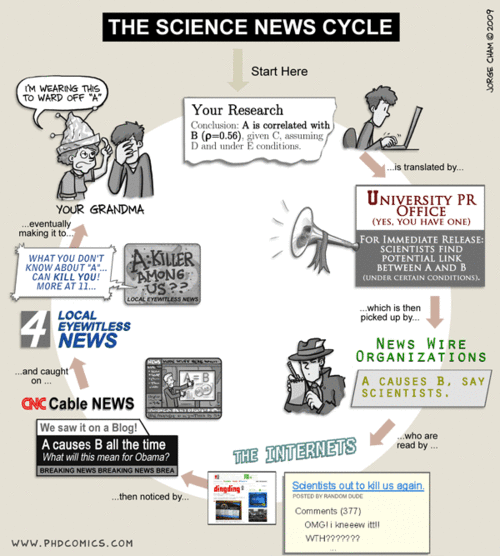
This week struck me as a particularly exhausting one when it came to that certain brand of provocatively-headlined-but-probably-not-what-you-think-it-is science news that we know and love hate.
As usual, it’s the science media click-machine that’s to blame, which is a polite way of saying that there exists a gaping void of careful, cautious, skeptical, dare I say scientific science writing out there amidst the great internet knowledge machine. It’s desperately hard to get people to read your articles or watch your videos, but that doesn’t mean that it’s okay to disengage the gravity of reason and drift off into the aether of just-so stories.
PHD Comics has summed up this vicious form of the science news cycle very well:
It’s not all bad, of course. There’s some real diamonds that we can regularly depend on to shine through amid the soiled throngs of pseudointellectual beggars out there, and I, along with others, try to highlight their work regularly. I shall do so again here.
Here, I present two cases of “science things that were badly reported” and some links to better explanations. As usual, the defendants come from that tenuous intersection of neuroscience and behavior, because studying the brain is hard stuff, folks.
1) Mice Can Inherit Memories: No they can’t. Well, maybe they can (although I doubt it), but that’s not at all what this widely-reported paper in Nature Neuroscience says. The poor authors of that study are probably at home, drinking, wondering how, after years of hard work, their paper about how mice may pass on sensitivity to smells got so twisted. Headlines ranged from declaring this the source of human phobias to saying that Assassin’s Creed is based in real science.
What the researchers did was to condition some male mice to associate a smell (cherry blossoms) with a mild electric shock, which is mean, because that’s a nice smell! Naturally, the mice began to avoid the odor. The weird part is that their offspring, even two generations down the line, also seemed to avoid that specific cherry blossom odor, without ever encountering it before (and without their dads showing them). The dads’ noses all had more of the cells that smell that odor, as did the noses of their offspring. This did not happen with female mice and their offspring.
These kind of things aren’t supposed to be possible in a single generation. A mouse dad shouldn’t smell something, become afraid of it, and then be able to pass on a change to his kids. That’s precisely the kind of thing that got Lamarck and his giraffe necks laughed at more than a century ago. But it is possible that these mice were transmitting some sort of epigenetic change.
It’s possible that there was an epigenetic change passed down. But it’s not for sure. Beyond that, the way that statistics are applied to mouse behavior studies make it possible that the differences they see are just due to sample sizes, or not including certain controls, or some other random factor like that the humidity on a particular day happened to make the mice very jumpy. There’s also the fact that there is no known way for nerve cell changes or chemical responses within the olfactory bulb to be communicated to the testes, where sperm are made (there’s literally a blood-testis barrier to prevent that kind of thing).
Read this instead: At National Geographic, Virginia Hughes goes through the research in great detail, including comments from several people in the field who remain, shall we say, less than convinced. Extraordinary claims call for extraordinary evidence, and that’s lacking, at least in part. “More work needed” as they say!
2) Men and women’s brains are wired differently, therefore men are better at reading maps. That’s almost a verbatim headline from this news outlet. It speaks of “hardwired differences” (our brains are not hardwired) and is loaded with brainsplaining and neurosexism. This story is frustrating notsomuch because of the science, which is so-so, but because it is being misapplied by the media to reinforce cutsie-pie stories about what men are good at and what women are good at and never the twain shall meet and boy is it funny how men and women argue over getting lost?! GUFFAW!
Read this instead: At Discover, Neuroskeptic explains why the spatial resolution of the techniques used are like making a road atlas, while on the moon, using a pair of binoculars, and how the only real difference here may be that men’s brains are just slightly bigger than women’s (which doesn’t account for any noticeable difference in abilities, but can mess with scans a lot). And if you’d like a nice introduction to the idea of neurosexism and pigeonholing gender-based brain research into outdated social molds, might I suggest you read this article at The Conversation?
The fact is that men and women are mostly the same when it comes to their brains, but “Everyone can probably become pretty good at reading maps whether or not they are male or female, suggests common sense, not needing to be backed up by neuroscience” doesn’t make a very catchy headline.
None of this is to say that any of the results presented in the scientific papers are patently or provably false. But as we communicate the vagaries of Science In Progress, we must include the Don’t Knows and the Possiblys and all the other fine (and frustrating) forms of cautious optimism. It doesn’t kill the excitement. It just comes with the territory. I read it on a map somewhere.
Suzanne Sadedin, Ph.D. in evolutionary biology from Monash University
I’m so glad you asked. Seriously. The answer to this question is one of the most illuminating and disturbing stories in human evolutionary biology, and almost nobody knows about it. And so, O my friends, gather close, and hear the extraordinary tale of:
HOW THE WOMAN GOT HER PERIOD
Contrary to popular belief, most mammals do not menstruate. In fact, it’s a feature exclusive to the higher primates and certain bats*. What’s more, modern women menstruate vastly more than any other animal. And it’s bloody stupid (sorry). A shameful waste of nutrients, disabling, and a dead giveaway to any nearby predators. To understand why we do it, you must first understand that you have been lied to, throughout your life, about the most intimate relationship you will ever experience: the mother-fetus bond.
Isn’t pregnancy beautiful? Look at any book about it. There’s the future mother, one hand resting gently on her belly. Her eyes misty with love and wonder. You sense she will do anything to nurture and protect this baby. And when you flip open the book, you read about more about this glorious symbiosis, the absolute altruism of female physiology designing a perfect environment for the growth of her child.
If you’ve actually been pregnant, you might know that the real story has some wrinkles. Those moments of sheer unadulterated altruism exist, but they’re interspersed with weeks or months of overwhelming nausea, exhaustion, crippling backache, incontinence, blood pressure issues and anxiety that you’ll be among the 15% of women who experience life-threatening complications.
From the perspective of most mammals, this is just crazy. Most mammals sail through pregnancy quite cheerfully, dodging predators and catching prey, even if they’re delivering litters of 12. So what makes us so special? The answer lies in our bizarre placenta. In most mammals, the placenta, which is part of the fetus, just interfaces with the surface of the mother’s blood vessels, allowing nutrients to cross to the little darling. Marsupials don’t even let their fetuses get to the blood: they merely secrete a sort of milk through the uterine wall. Only a few mammalian groups, including primates and mice, have evolved what is known as a “hemochorial” placenta, and ours is possibly the nastiest of all.
Inside the uterus we have a thick layer of endometrial tissue, which contains only tiny blood vessels. The endometrium seals off our main blood supply from the newly implanted embryo. The growing placenta literally burrows through this layer, rips into arterial walls and re-wires them to channel blood straight to the hungry embryo. It delves deep into the surrounding tissues, razes them and pumps the arteries full of hormones so they expand into the space created. It paralyzes these arteries so the mother cannot even constrict them.
What this means is that the growing fetus now has direct, unrestricted access to its mother’s blood supply. It can manufacture hormones and use them to manipulate her. It can, for instance, increase her blood sugar, dilate her arteries, and inflate her blood pressure to provide itself with more nutrients. And it does. Some fetal cells find their way through the placenta and into the mother’s bloodstream. They will grow in her blood and organs, and even in her brain, for the rest of her life, making her a genetic chimera**.
This might seem rather disrespectful. In fact, it’s sibling rivalry at its evolutionary best. You see, mother and fetus have quite distinct evolutionary interests. The mother ‘wants’ to dedicate approximately equal resources to all her surviving children, including possible future children, and none to those who will die. The fetus ‘wants’ to survive, and take as much as it can get. (The quotes are to indicate that this isn’t about what they consciously want, but about what evolution tends to optimize.)
There’s also a third player here – the father, whose interests align still less with the mother’s because her other offspring may not be his. Through a process called genomic imprinting, certain fetal genes inherited from the father can activate in the placenta. These genes ruthlessly promote the welfare of the offspring at the mother’s expense.
How did we come to acquire this ravenous hemochorial placenta which gives our fetuses and their fathers such unusual power? Whilst we can see some trend toward increasingly invasive placentae within primates, the full answer is lost in the mists of time. Uteri do not fossilize well.
The consequences, however, are clear. Normal mammalian pregnancy is a well-ordered affair because the mother is a despot. Her offspring live or die at her will; she controls their nutrient supply, and she can expel or reabsorb them any time. Human pregnancy, on the other hand, is run by committee – and not just any committee, but one whose members often have very different, competing interests and share only partial information. It’s a tug-of-war that not infrequently deteriorates to a tussle and, occasionally, to outright warfare. Many potentially lethal disorders, such as ectopic pregnancy, gestational diabetes, and pre-eclampsia can be traced to mis-steps in this intimate game.
What does all this have to do with menstruation? We’re getting there.
From a female perspective, pregnancy is always a huge investment. Even more so if her species has a hemochorial placenta. Once that placenta is in place, she not only loses full control of her own hormones, she also risks hemorrhage when it comes out. So it makes sense that females want to screen embryos very, very carefully. Going through pregnancy with a weak, inviable or even sub-par fetus isn’t worth it.
That’s where the endometrium comes in. You’ve probably read about how the endometrium is this snuggly, welcoming environment just waiting to enfold the delicate young embryo in its nurturing embrace. In fact, it’s quite the reverse. Researchers, bless their curious little hearts, have tried to implant embryos all over the bodies of mice. The single most difficult place for them to grow was – the endometrium.
Far from offering a nurturing embrace, the endometrium is a lethal testing-ground which only the toughest embryos survive. The longer the female can delay that placenta reaching her bloodstream, the longer she has to decide if she wants to dispose of this embryo without significant cost. The embryo, in contrast, wants to implant its placenta as quickly as possible, both to obtain access to its mother’s rich blood, and to increase her stake in its survival. For this reason, the endometrium got thicker and tougher – and the fetal placenta got correspondingly more aggressive.
But this development posed a further problem: what to do when the embryo died or was stuck half-alive in the uterus? The blood supply to the endometrial surface must be restricted, or the embryo would simply attach the placenta there. But restricting the blood supply makes the tissue weakly responsive to hormonal signals from the mother – and potentially more responsive to signals from nearby embryos, who naturally would like to persuade the endometrium to be more friendly. In addition, this makes it vulnerable to infection, especially when it already contains dead and dying tissues.
The solution, for higher primates, was to slough off the whole superficial endometrium – dying embryos and all – after every ovulation that didn’t result in a healthy pregnancy. It’s not exactly brilliant, but it works, and most importantly, it’s easily achieved by making some alterations to a chemical pathway normally used by the fetus during pregnancy. In other words, it’s just the kind of effect natural selection is renowned for: odd, hackish solutions that work to solve proximate problems. It’s not quite as bad as it seems, because in nature, women would experience periods quite rarely – probably no more than a few tens of times in their lives between lactational amenorrhea and pregnancies***.
We don’t really know how our hyper-aggressive placenta is linked to the other traits that combine to make humanity unique. But these traits did emerge together somehow, and that means in some sense the ancients were perhaps right. When we metaphorically ‘ate the fruit of knowledge’ – when we began our journey toward science and technology that would separate us from innocent animals and also lead to our peculiar sense of sexual morality – perhaps that was the same time the unique suffering of menstruation, pregnancy and childbirth was inflicted on women. All thanks to the evolution of the hemochorial placenta.
“intersexism does not disprove dimorphism” first of all, fuck you for dehumanising me “intersexism” wtf is that bullshit
second, @hollyjollyjustice can u send me some resources to roast this radscum bullshit since you’re a biology major? if not that’s totally fine
*Rubs hands together*
My time has come. I don’t have alot of online sources because most of this has come from either my paper and ink textbooks or professors.
Which is pretty legit considering I go to the top undergraduate university in Canada, UNBC. My education is pretty legit. So I can give you a rundown.
The whole concept of ‘biological sex’ and sexual dimorphism in humans is based in a basic misunderstanding of how science and biology as a science defines sex.
The definition of sex is so wildly different in different offshoots of biology that it’s ridicules. Botanists often define it as if something gives gametes or receives, and sex is often narrowed down to one part of a plant, not the whole. Biologists who study animals define sex differently depending on what animal they work on, and in many cases have to either have to inaccurately describe something as male or female or abandon the binary completely.
In human, medical biology sex is defined by a list of about 6 different types of sexes. There’s chromosomal sex (the chromosomes present), nuclear sex (the phenotype of the chromosomes ie how that chromosome pattern actually looks), endocrinologic sex (sex based off the phenotypes influenced by endocrine system), sex hormones (the balance of testosterone and estrogen, along with other influencing hormones), gonadal sex (based on gonadal tissue like ovaries), and morphological sex (the appearence of external genitals).
That’s alot of categories to fit into. And alot of them have blurred edges. None of them have an easy black and white, male or female to them, They’re all nuanced and affected by many different factors. Nuclear sex could indicate a female result and endocrinalogic sex could say male while chromosomal sex says an xx/xy mosaic.
Intersex people aren’t some mutation out of a clear black and white binary. Intersex people are proof that our system of sex sucks for humans. There are too many categories with ill defined lines for everyone to fit into. Life is messy. Genetics is messy. You can’t fit humans into an easy two sex binary because there is much too much variation.
Sexual dimorphism barely works for non-human animals. A sex binary works best for science when we’re trying to study other animals. It’s easier to figure out the behavioral patterns of salmon if we can split them into two groups, those that lay the eggs and those that fertilize them. It makes fish counts easier to understand, data easier to interpret. It helps us learn more about species that aren’t us.
But we don’t need that for humans. Humans can communicate with each other. We have a knowledge of our bodies that far surpasses what we will know about any other species.
The studies done on humans right now have surpassed the point where a ‘biological sex’ is useful. At this point instead of simplifying, it introduces more variables.
If your cancer research focuses on people with a certain level of estrogen then defining them as women muddies your results. how many of these ‘women’ have had chromosome testing, how many have gonadal tissue still, how many fit the same morphological sex, how many of them have large amounts of breast tissue?
If a ‘biological’ woman gets a mastectomy and no longer fits that part
of the endocrinological definition of female is she no longer female? If
a ‘biological’ woman has cancer and gets her ovaries removed,
nullifying a gonadal sex definition is she still female.
If your study doesn’t account for outliers, then it’s a shitty study. Sexual dimorphism in humans automatically has many outliers.
The idea of a cut and dry sex binary only fits into a elementary school level of biology. It, like much of the other oversimplified nonsense we teach children, does not reflect the scientific reality.
So In conclusion:
Sex is so much more complicated than ‘this = girl this =boy’
There are many factors that determine sex, none of which have nice, black and white definitions
Sexual dimorphism is a thing only useful for the study of nonhuman organisms, humans have moved past it’s usefulness
‘Biological sex’ is a simplified definition taught in elementary and highschools; but they also taught you in elementary school that the great wall of china can be seen from space and that there are only 5 senses and both of those are just plain wrong.
As a note:
If anyone wants to hear more biology ranting like this just as, I’m always a slut for a analysis of the current state of biology and it’s relations to culture. And if anyone want’s to use my word’s to slam some nonsense go ahead and quote me! Just @ me so I can see it. If I have the spoons, I’d love to help you correct someone knowledge of science.
there has been a pretty far-reaching trend on this website to blog about the effects of mental illness and trauma on emotional regulation and an aggressive campaign to get people to not only understand but accept boundary-crossing behavior from people because it is a reflection of their mental illness/trauma, as far as to imply that you are ableist if you are not able to tactfully handle and accept someone else’s dysfunctional coping mechanisms and behavior despite your own discomfort. i see this most often with posts about bpd but there are other topics as well. i haven’t commented on any of it because it’s not a pie i wanted a finger in, but it has over time led me to develop severe discomfort around people who follow that line of thought to the point that i have disengaged, unfollowed, and unfriended many people who agree with it.
the stuff i’m seeing passed around now about “supporting perpretrators” in addition to survivors is the horrifying track down which that train of thought has sped, because what people don’t seem to understand is that mental illness and trauma do no make you an exception to the boundaries of those around you. it is necessary to be aware of the ways that survivors and mentally ill people may lash out emotionally at those they are close to but it is not actually necessary to be “accepting” to the point that it is harmful to you. your emotional boundaries are important, more important than whatever obligation you feel to “accommodate” someone’s trauma.
it is not “okay” that survivors sometimes display manipulative/abusive behaviors towards the people around them and it is important to handle these situations with tact, sure, but not to the detriment of setting your own boundaries and checking the behaviors in question. when friends i know are mentally ill/ trauma survivors have lashed out at me with emotionally manipulation tactics in times of great distress, i have supported them afterward, but i have always followed this up with a discussion about how these kinds of behaviors can not and will not continue or our relationship will end. this is not “ableist” or refusing to support survivors’ trauma, it is setting strong boundaries within the context of supporting each other and providing the community in which we all can heal. what is important here is that these are isolated incidents – learned defense mechanisms arising in times of panic and stress – and not consistent grabs for power. these are not people following the deliberate, overarching pattern of actions abusers use to isolate and control victims, and their actions are easily distinguishable from such.
my point is that this discourse has allowed people to blur the line between these behaviors and abuse when it comes to community support. we should support abusers in our communities as well, they say, because otherwise we would be isolating vulnerable marginalized people who are just struggling with their own trauma. this is exactly what abusers want. this is not a radical attitude. abusers depicting themselves as helpless victims of emotions and circumstances out of their control has pretty much always been the abuser party line. there is nothing productive or useful or valid about carving out community resources for “accountability” in ways that perpetuate bad abuse politics and logics that have been used to silence survivors for years and years. you cannot support survivors and also support their abusers by continuing to welcome them in the same community spaces, period, and it takes some ridiculous mental gymnastics to pretend otherwise.
I’m out to my friends and family. Most people at work know too. Everyone is cool with it. Yes, thanks to my fabulous sister they’ve done it before, but also because they’re fantastic people. Without the love and support of my wife and friends and family I would not be where I am today.
Lilly Wachowski
While yes, we should celebrate Lilly, please don’t forget that she was basically intimidated into coming out by the media – notably the Daily Mail, the notorious british tabloid – and yes the statement above is uplifting, but I feel it’s kind of covering up the circumstances a lot and I know a lot of people won’t follow the link to the article.
Another extract from the statement in the Windy City Times:
“My sister Lana and I have largely avoided the press. I find talking about my art frustratingly tedious and talking about myself a wholly mortifying experience. I knew at some point I would have to come out publicly. You know, when you’re living as an out transgender person it’s … kind of difficult to hide. I just wanted—needed some time to get my head right, to feel comfortable.
But apparently I don’t get to decide this.
After he had given me his card, and I closed the door it began to dawn on me where I had heard of the Daily Mail. It was the “news” organization that had played a huge part in the national public outing of Lucy Meadows, an elementary school teacher and trans woman in the UK. An editorial in the “not-a-tabloid” demonized her as a damaging influence on the children’s delicate innocence and summarized “he’s not only trapped in the wrong body, he’s in the wrong job.” The reason I knew about her wasn’t because she was transgender it was because three months after the Daily Mail article came out, Lucy committed suicide.
And now here they were, at my front door, almost as if to say—
“There’s another one! Let’s drag ‘em out in the open so we can all have a look!”
Being transgender is not easy. We live in a majority-enforced gender binary world. This means when you’re transgender you have to face the hard reality of living the rest of your life in a world that is openly hostile to you.
I am one of the lucky ones. Having the support of my family and the means to afford doctors and therapists has given me the chance to actually survive this process. Transgender people without support, means and privilege do not have this luxury. And many do not survive. In 2015, the transgender murder rate hit an all-time high in this country. A horrifying disproportionate number of the victims were trans women of color. These are only the recorded homicides so, since trans people do not all fit in the tidy gender binary statistics of murder rates, it means the actual numbers are higher.
And though we have come a long way since Silence of the Lambs, we continue to be demonized and vilified in the media where attack ads portray us as potential predators to keep us from even using the goddamn bathroom. The so-called bathroom bills that are popping up all over this country do not keep children safe, they force trans people into using bathrooms where they can be beaten and or murdered. We are not predators, we are prey.
So yes, Lilly is a fantastic woman, and I am happy that she is comfortably out in her own support network and community. But please remember that she only outed herself publicly because if she didn’t do it herself, the press were going to kick up a fuss.
Please note: I am cis, and I don’t want to speak for or over trans people, I’m simply highlighting what I think is the more important message to take from this press statement.
My parents got me this Trump doll as a gag gift over a decade ago when we were fans of the Apprentice.
Fun Super Tuesday activity: For every ten notes I’ll stick a pin in him until I’m out of pins. Don’t let me down America
Seems like Donald will wake up tomorrow with “stabbing” shoulder pains…
Right in the heart. That one went in easy. Like there was already a hollow space there.
Now in the stomach, like how I can’t stomach his fuckin bullshit
Let’s see you try to “pin” this on Mexican kidney thieves
Hearing no evil is hard when you’re Donald Trump and your mouth is a direct spigot from Hell’s pipeline of villainy
I believe we’ve pinpointed the source of his hot air.
Donald Trump is the arch-nemesis of liberty.
Woops, sorry about that D, looks as though I cut off your freedom of choice over your reproductive decisions
OK – I can’t keep up with the demand, and I’m running out of jokes and pins, so let’s skip to the good stuff. The inevitable conclusion where he’s just absolutely covered in pins.
This Donald is sure not having a Super Tuesday! 🙂
~~ Stretch goals ~~
800 notes – attacked by vicious alligator
1,500 notes – confronted with flagrant multiculturalism
2,000 notes – sent directly back to hell
Reached our first stretch goal… attacked by not one, but six vicious alligators. Don’t say I never gave you anything nice.
Kind of an interesting question here, though you must be careful with words like ‘purpose’ when describing the way animals have evolved- there’s no purpose about it, it’s literally what randomly came together and worked.
The life cycle of the crane fly only seems confusing if you look at it from a human standpoint. Certainly it seems to us that the most proper life cycle includes a short nonreproductive juvenile period and a much longer reproductive-capable adult period. This, after all, is how most the lives of most vertebrates are structured. For example, a dog lives perhaps an average of twelve years, and only spends about six months of that time growing to sexual maturity.
And it does confer advantages from an evolutionary standpoint: having most of your life available to find mates seems like a pretty good way to maximize the number of offspring you produce. Here’s a really lazy timeline of that strategy, which in scientific terms is called an iteoparous lifestyle:
But there’s a danger in assuming that the juvenile period is wasted time, which it isn’t- otherwise it wouldn’t exist. Evolution rewards species that can successfully propagate themselves, and the timing of the nonreproductive period hinges on this. You see, there’s a slight problem with being ~READY TO BONE~ 24/7. Sexual organs, sexual secretions, and sexual behavior are all extraordinarily expensive. I’m not just talking about being sweaty and tired after a netflix and chill marathon. I’m talking about the biological costs incurred by producing eggs, sperm, secondary sex characteristics like giant antlers on deer and gaudy tails on peacocks, building nests for eggs, competing for opposite-sex attention and fighting off other suitors, and heck, even finding the dang object of your attraction. Think about how successful dating sites are, for goodness’ sake. In the US alone, about $80 million each year gets spent by horny people on dates.
Knowing how expensive all this can get, perhaps now it’s less surprising that some species want to make sure their offspring are as prepared as possible before they’re thrust into the Lust Pit. This may mean that they have proportionally longer juvenile periods than reproductive periods- however, when Fuck Time comes, they have a much better chance of finding a partner than you do on OkCupid because the entire species has synchronized their genitalia to develop at the same time. They may not even eat or sleep- they spend their last few weeks, days, or hours in a furious haze of lovemaking. Sometimes until they literally fall apart, in the case of the antechinus, a little marsupial that has such furious sex that he’ll lose all his hair and bleed internally (and then die). Which you wouldn’t expect when you see one:
This type of get-fucked-or-die-trying lifestyle is called semelparity, in contrast to our own iteroparity. Here’s another lazy timeline of that:
Semelparous animals sync up their breeding cycles to maximize their chances of finding a mate. This means it’d be pointlessly expensive to be reproductively primed during the off-season. Instead, they focus on preparation: growing as large and strong as they can so that when the time comes, they have the best chance possible. One of the best examples of this is the cicada, which is likely the longest-living insect- some species live up to 17 years. However, of those 17 years, only 2-4 weeks are spent as sexually mature adults. Emerging en masse after such a long absence not only makes it much easier to find a mate, it also overwhelms potential predators. Yes, cicadas are delicious, but you can only eat so many in two weeks compared to how many you could eat if they spent all seventeen years not buried deep underground.
Periodical cicadas are an extreme example, but many other animals have similar strategies. Calling something short-lived a “mayfly” refers to the fact that the sexually mature form is extraordinarily short-lived- in one species, it lives for less than five minutes. However, it’s often forgotten that this only refers to the adult form; the larvae will live possibly two years in rivers or streams.
It’s not just invertebrates that practice extreme semelparity. I already mentioned the little antechinus- the males of that species, by the way, live less than a year, while the females live for two years and generally die after weaning their first litter. Pacific salmon are another familiar semelparous species, which spend up to five years in the ocean before returning to freshwater to spawn and die within the span of a few days.
Perhaps the most extreme example of a semelparous vertebrate that I know of is Labord’s chameleon. The eggs of this species take roughly 9 months to incubate before hatching. After hatching, the juveniles reach sexual maturity at about two months old- and die another two months later. That’s right: this species of chameleon spends more time in an egg than it does in the outside world. Not only that, but because the mating takes place seasonally, there are long periods of time in which no adultindividuals of the species exist. All of them are encased in eggs- silently growing, and preparing for the pinnacle of their lives: the Great Fuckening.
Oh boy. Oh, oh boy. I’ve hung on to this ask for a while now because the history of apes and language research is a lot of shit to unravel.
It all honestly stems from a weird colonialist mindset (with racist undertones) that by gosh, we can teach these creatures to be human/civilized. The idea that great apes and other creatures like elephants and parrots have some hidden potential that is just waiting to be unlocked by the right scientist is, in my mind, nearly as awful as the mindset of European colonists who “discovered” foreign tribespeople and decided that they could be uplifted with the introduction of proper culture and manners. Not ever quite equal to the Europeans, mind you, but certainly similar enough to be charming.
Image above: The young chimpanzee Gua was one of the first documented cross-rearing experiments with great apes. Gua was returned to a zoo after her handlers’ ten-month-old son began imitating her sounds, not the other way around.
Does this seem too harsh? I’m sorry, but there are cruel parallels there
we can’t ignore. To assume that there is potential inside an animal we
can ‘unlock’ with the right coaxing is to assume that animals in the
wild are too stupid to do it on their own. That’s the crux of it. Other species do not communicate with each other the same way that we do. Of course they are not going to be able to mimic our methods perfectly. It would be ridiculous to me if a gorilla like Koko could speak in flawless sign language, because again, gorillas do not communicate the same way we do.
I should stop and say I don’t mean this as an indictment of you or anyone else who is fascinated by great ape language research. It is fascinating- but it is also rooted in a very, very sad and flawed history, and we cannot forget that. And we have to remember that something like an animal’s emotional intelligence is not proved or disproved by their ability to do human activities like painting pictures.
Again: see the shadiness? “Unless these animals can act like me, they aren’t intelligent.” That’s a messed-up way of thinking.
Until recently, all ape language experiments started with removing the apes from their mothers at birth and rearing them like humans. Unfortunately, as stated before, apes are not human. Koko, still in contact with her handlers as an adult, is a rarity: most of these experiments terminated after three months, when the apes became too strong and unruly to handle. These apes, raised like human children, then had to struggle to socialize with their own species once returned to them.
You don’t have to consider the living conditions of Koko, in particular, to realize that there are some things which seem terribly off about it. A stable gorilla social unit in the wild, as far as female gorillas are concerned, is a group of around five or more females along with their young of both sexes and one adult male. These females are a close-knit group of mothers, sisters, aunts, and cousins that generally stay together for life (unless the group becomes too large and splits). But Koko has lived most of her life alone, with occasional male companions such as Michael or Ndume (who she currently only sees through a fence barrier). Human companions do not make up for other gorillas.
Yes, Koko is overweight. Yes, her diet, as far as I’ve read, is crap. Gorillas almost never eat meat: she eats lots. They don’t eat much salt and refined sugar in the wild: she gets lots. She also apparently receives homeopathic medications, which no legitimately scientific organization should touch with a ten-foot pole.
And as for the scientific legitimacy of The Gorilla Foundation, which houses Koko? Well, how much new ape language research have you read from them in the past ten years? The place is still running, but the only paper I’ve seen concerning Koko in recent times concerns her ability to manage her breathing when playing with wind instruments. Interesting, but not exactly breaking any interspecies barriers. And the research on Koko does very little to help us understand and protect endangered wild apes. In fact, other research suggests that making apes act in humanlike ways reduces the public’s interest in conserving their wild counterparts.
Most of the ‘research’ on Koko is composed of anecdotes, and most of those anecdotes come from Francine “Penny” Patterson, Koko’s primary caretaker and the director of the gorilla foundation. In most videos provided to the public, what Koko signs, Penny interprets to the audience. Koko uses a modified version of American sign language called “gorilla sign language” (GSL), which means that even ASL speakers may not be able to interpret what she’s signing. Right now, a tiny number of people have the ability to interpret Koko, which is not good on the scientific front. It reminds me very much of the facilitated communication scandal that occurred in the 90s, where ‘facilitators’ claimed to be the only ones who could interpret the language of autistic children.
Now, I am not saying that great apes cannot communicate some things using sign language. (Nor am I trying to say that the plight of great apes is equivalent to the autistic children abused through facilitated communication or the people oppressed by European colonizers. Though the Gorilla Foundation apparently doesn’t mind equating apes to humans with disabilities.) There is certainly evidence that great apes can learn to identify objects using symbols, such as lexigrams or signs. Indeed, many wild animals use representative sounds or gestures for specific items, such as predators or types of food. But humans use language in more abstract ways than merely identifying objects- we are able to discuss the past and present and things about people who aren’t in the room. The evidence that apes can communicate things like this through sign language or other forms of symbolic communication isn’t just limited- it’s basically nonexistent. (Notice that I’m only talking about communication here- apes may still be able to understand things like this while not being able to communicate them with others!)
Dressing apes up as humans an trying to teach them to talk the way we do was a research fad that appears to be, thank goodness, in its death throes. You can’t find much research about it in the past ten years that wasn’t published by Sue Savage-Rumbaugh, who has an equally problematic history with her captive bonobos as Penny Patterson has with Koko. This is because it’s considered barely scientifically valid by the science community is large. The question, “Can apes communicate just like people do?” is a resounding “No,” as far as science is concerned.
Most research on ape communication is now focused on the study of natural behaviors of apes, such as gestures used by wild chimpanzees. These will teach us much more about chimpanzees than any cross-rearing study ever will. We should be focusing on understanding the apes, rather than trying to get them to use human languages they are poorly equipped to use.
In closing: I haven’t even touched many of the issues with ape language studies, such as the sexual harassment scandal against Patterson and the experiments on Nim Chimpsky because this answer has gone on far too long. It is a tangled goddamn nightmare out there. I know that many people want to focus on the ‘they’re just like us!’ aspect and ignore the rampant abuse heaped on the animals in question- but if you truly love apes, you cannot. Suffice it to say: if you are looking for signs of emotional intelligence and social cognition in the great apes, please look for it in apes acting like apes, not apes acting like humans.








 EY FATTY BOOM BOOM