Legends say that hummingbirds float free of time, carrying our hopes
for love, joy and celebration. Like a hummingbird, we aspire to hover
and savor each moment as it passes; embrace all that life has to offer
and to celebrate the joy of every day. The hummingbird’s delicate
grace reminds us that life is rich, beauty is everywhere, every
personal connection has meaning and that laughter is life’s sweetest
creation. –Papyrus
I…Ah…hmm.
Look, it’s a great photo. The photographer kicked butt. They should be very proud of this photo.
But hummingbirds are not carrying your hopes for joy around. I am sorry. Have you met hummingbirds? Hummingbirds believe strongly that they should be eighteen feet tall and have flamethrowers. They are a half ton of pugnacious wrapped up in a half ounce of feathers. Given the choice, hummingbirds would fly around with “Ride of the Valkyries” blasting out of tiny speakers on their wings, putting the eyes out of their enemies.
They do not fear humans, but if they learn that humans will provide feeders, they will become very demanding. They are fiercely territorial. They are…kind of jerks, actually.
Also, there are papers indicating that female hummingbirds engage in what can only be termed “nectar-based prostitution” where they trade sexual favors to males in return for access to particularly rich nectar sources.
If your hopes for love involve nectar and your hopes for joy involve crushing your foes, seeing them driven before you, hearing the lamentations of their nestlings, etc, then possibly the hummingbird may carry them around, otherwise…uh…have you considered vultures? Vultures are very pleasant, affectionate, and social birds. You should probably give them your hopes and dreams. They would be better at it.
Did I mention it’s a great photo?
VULTURES, NOW.
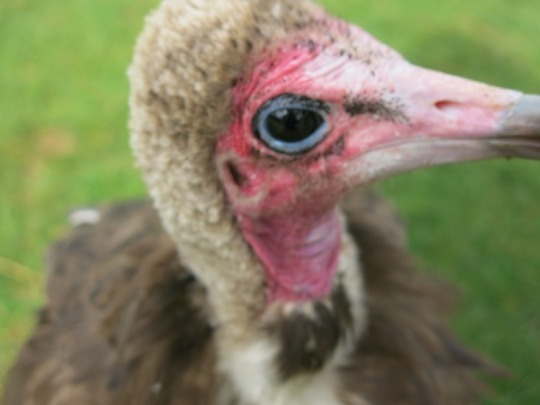
this is Jack.
Jack (full name: Jack Sparrow) lives at the Hawk Conservancy. (He’s missing some toes because he was rescued from Vulture Smugglers.)
When you interact with Jack, you can tell he’s at about the level of … something between a ferret and a dog. Funny short little attention span, and a weird face to look at, but a human reads him as curious, friendly and interested in people.
When you meet a working vulture, you realize that they are definitely a wild predatory animal and very instinctive, but with a
consciousness that extends to interest in their surroundings; like, he’s
very much focused on THE SNACK, but before and after the SNACKTIME he
also wants to have a chat about your day and look at your face and peer into your camera and ask to look at the pictures you took and then say “hey now take one where I’m doing duckface” and you’re like “ok Jack go ahead”
Contrast with owls, which are typically pretty, but which are basically as interactive as a pop-up ad. They exist to land on things and eat them. They are not complicated. Vultures are hey-whatcha-doin. They’re yeah I’m a psychopomp but my real hobby is DJ-ing. They’d like to couchsurf next time they’re in town. You’d let them.
I would give Jack my dreams to carry. He would hold them well, in his big black lovely inky eyes, in his broken gentle feet.
Festooning, bearding, and air conditioning are some of the cutest things bees do. When you take frames out of busy lower supers, you will usually always get a bee “daisy chain” of festooners trying to keep you from tugging the frame out.
The air conditioning is my favorite, though. You will see a little line of workers sitting at the front of the hive with their butts facing the entrance, and they will all start rapidly buzzing their wings. They’re blowing “cooler” air into the entrance to try and bring the hive temperature down so that the gals inside can work more efficiently.
Tips for respecting children’s spaces, competence, and general existence from a preschool teacher:
Listen to them
Ask them, “Do you want to say hi to your auntie/grandma/cousin/dad/whatevs” (Hint: they will be honest and this can result in a simple hello or a hug or a silly “No!” depending how comfortable they feel)
If they don’t want to hug you realize it’s not that they don’t love you it’s that they don’t know you/don’t feel like hugging.
Just like every other person who doesn’t want a hug
In the event that you need to move a child EXPLAIN TO THEM WHY and WHAT YOU ARE DOING don’t just move them like PROPS they are CHILDREN and NOT props
For instance, “I’m going to move your chair over so we have room at the table for everyone!”
Or “Sorry there was a person running by I didn’t want you to get smushed so I had to pick you up!”
Remind them that they are people not objects using your actions
Asking children to do something they don’t want to do but NEED to do often doesn’t work, instead give them a choice, “Do you want to eat bok choy or yams?”
NOT “Do you want to eat your vegetables?”
“Do you want to brush your teeth in the bathroom or the kitchen”
This exercises their ever-growing free will and is especially useful during TERRIFIC TWOS okay TERRIFIC not TERRIBLE they’re TERRIFIC
Children will copy you, MODEL FOR THEM
Being over enthusiastic IS beneficial for them understanding emotional and social competence
“I hung this picture uneven, that makes me sad, hmmm! Oh goodie, I found my mistake! Now I can fix it, I’ll feel much happier when I’ve fixed it!”
You think it sounds ridic yeah well hearing you do that children around you just learned to not get so discouraged by their mistakes and that it’s okay to try to fix them
ADULTS CAN APOLOGIZE TO CHILDREN
You make a mistake that hurt a child, APOLOGIZE and show them how to do it properly and genuinely
Realize children are fully competent and are capable of making meanings from YOUR implications about race, culture, gender, ability, sexuality, EVERYTHING
Many three year olds know what the N-word is, what gay means, can identify which children are visably disabled, and YOUR REACTIONS of their answers of questions about their culture
Children like to talk about themselves so do not ever dismiss what they say about themselves as illegitimate just because it sounds silly or unlikely sometimes it’s true
Stop talking about how you hate children, just leave them alone if you don’t understand them you don’t have to be complete jerks to PEOPLE you’ve never met
I will post more and if people have question PLS ASK ME I WOULD LOVE TO ANSWER WHAT I KNOW
“Queer, in the usage we know today, took on a new life during the Revolutionary period (1789-94). It is instructive to see how the historical evolution of the relationship between wastefulness and artificiality and queer style.
During the Revolution, suspicion shifted from the private body to that of the political body. Any fashion and dress that smack of the old extravagant ways, any suggestion of frippery was dealt a cold hand. William Hogarth did an engraving, which is now quite well-known, of the five orders of wigs, from âEpiscopal or Parsonicâ to âQueerinthianââ the latter in this case less macaroni-like as it did not feature a ridiculous amount of hair dangling from a  bow. Wearing big hair was not just denigrated because of its obvious ostentation; it was also something that demanded a large amount of time to make. When big hair reached its zenith in the late eighteenth century, it constituted what Margaret Powell and Joseph Roach call âthe performance of wasteâ; time that, to the sternest Revolutionary middle-class mind, could be spent more sensibly. Any form of overwrought fastidiousness of appearance smacked of the same: it was an uneconomical use of time that could serve better ends. Even Robespierre, known for his immaculate clothing and insistence on maintaining a wit, came in for criticism.
In sum, all aristocrats were âpansiesâ: aristocratic values and fashions were all relegated to the status of effeminacy, a male effeminacy that linked to fecklessness, insincerity and improvidence.”
Daytime male dress also changed. Nineteenth-century’s women’s fashions, dominated by the corset and bustle, accentuated the female’s bosom and backside. In short her sexuality was magnified, but at the same time men’s sexuality was hidden. Male fashions no longer drew attention to the legs and thighs. The tight breeches and stockings were replaced by the 1830s in England by looser fitting trousers. And the “full fall” of the breeches was replaced by the 1860s with the more discreet buttoned fly front. For formal occasions the middle-class male donned a black three-piece suit. For every day dress, drab grays, blues, and browns replaced lighter colors and coarser wools the finer fabrics. Recourse by men to corsets and cosmetics became a laughing matter. Swords were replaced by walking sticks; ostentatious jewelry by utilitarian watches and fobs. By the twentieth century, the only hints of color were found in the tie or cravat, which led the eye away from the genitals up to the man’s head. A glance at a portrait of Marx or Engels reminds us that even political radicals donned the new uniform of the bourgeoisie. The tone had been set by the American revolutionaries’ contempt for “Yankee Doodle Dandy” and the French sans-culottes of 1789, who attacked as reactionary and pretentious fops men who affected too much attention to their dress. In response the pose of the dandy was taken up by such decadent artists and bohemians as Baudelaire, Barbey d’Aurveilly, Wilde, Swinburne, and Beardsley who wished to parade their disdain for middle-class proprieties. The extent to which Western society sought to hide the male body was perhaps best evidenced in nineteenth-century artistic representations. Female nudes were found in libraries and town halls, representing everything from “Liberty” and “Electricity” to “Slavery” and “Morphine.” The nude male virtually disappeared from the painter’s canvas. Visitors to galleries could imagine a no more shocking idea than that of a naked man as a subject for artistic representation.
Angus McLaren, The Trials of Masculinity: Policing Sexual Boundaries (via publius-esquire)



 EY FATTY BOOM BOOM