aaaa obrigada!!
Categoria: Sem categoria
We have at least one dramatic ancient story that illustrates the danger of hooking your house up to a public sewer in the first or second century AD. The author Aelian tells us about a wealthy Iberian merchant in the city of Puteoli; every night a giant octopus swam into the sewer from the sea and proceeded up through the house drain in the toilet to eat all the pickled fish stored in his well-stocked pantry.
“What toilets and sewers tell us about ancient Roman sanitation” (via rangi42)
But why didn’t they adopt him?

Getting pharma money out of medicine is as urgent as getting money out of politics. Corruption in healthcare choices supplants the best interests of the patient.
Doctors paid by drug companies more likely to use those companies’ meds
Ophthalmologists who receive money from
pharmaceutical companies are more likely to prescribe medications
promoted by those companies than similar drugs that are less costly, a
new study shows.
Although the
data can’t confirm a cause and effect, researchers at Washington
University School of Medicine in St. Louis found a positive association
between reported pharmaceutical payments and increased use of drugs
prescribed to treat problems of the retina.The study is published online in the journal JAMA Ophthalmology.
Pharmaceutical companies often pay physicians for consulting,
speaking and sharing their expertise, but there are concerns that such
payments may influence some doctors’ prescribing practices. In 2010,
Congress passed the U.S. Physician Payments Sunshine Act, requiring
pharmaceutical and medical device companies to report all payments made
to physicians. The Washington University researchers analyzed data about
ophthalmologists that was made available as a result of that law.“There has been a lot of interest in the associations between industry payments and physician behavior, but the scientific data
that would allow us to tease out those relationships have not been
available to the extent that the information is available now,” said
senior investigator Rajendra S. Apte, PhD, MD, the Paul A. Cibis
Distinguished Professor of Ophthalmology & Visual Sciences at
Washington University. “I’m not willing to draw conclusions about
causality, but there is an association between contacts with industry
and prescribing patterns.”

Another case of “it would have been nice to know the health risks (or lack of) BEFORE they were marketed and used everywhere. “
FDA has a few questions for makers of hand sanitizer
Federal health officials want to know
whether hand sanitizers used by millions of Americans work as well as
manufacturers claim—and whether there are any health risks to their
growing use.
The Food and
Drug Administration is asking for new studies on how the antiseptic gels
and rubs fight germs and get absorbed into the body, with a particular
focus on children and pregnant women. The proposal unveiled Wednesday is
part of an ongoing government effort to review decades-old chemicals
that have never had a comprehensive federal review.Agency officials stressed that the review “does not mean the FDA believes these products are ineffective or unsafe.”
Hand sanitizers have become nearly ubiquitous over the last 20 years,
offered in workplaces, schools, restaurants and other public spaces to
reduce the spread of germs. Since 2009, about 90 percent of sanitizers
sold to the public have included either ethanol or ethyl alcohol,
according to agency officials.Under current regulations, manufacturers can make broad claims about
their products’ effectiveness in killing germs. Bottles of Purell hand
sanitizer, for example, say: “Kills 99.99 percent of illness-causing
germs.”FDA regulators suggested they may tighten such claims after reviewing the information submitted by manufacturers.
“We’re not trying to alarm people,” said Dr. Janet Woodcock, director
of the FDA’s drug center. “Obviously ethanol and humans have co-existed
for a long time so there’s a lot that’s known about it.”But the agency has concerns about the possible long-term consequences
of frequent use by children and women of child-bearing age,
particularly those who are pregnant or breast feeding. The agency’s
proposal would require manufacturers to study whether three anti-germ
ingredients—ethanol, alcohol and a type of chloride—show up in blood or
urine after repeated, daily use. That could mean that the chemicals may
be affecting the reproductive system or the production of hormones.Regulators are also concerned about possible links between use of
antiseptic chemicals and the emergence of so-called superbug bacteria,
which are resistant to antibiotics.“We need to get this additional information so if there are
situations where caution is warranted we can label that or inform the
public,” Woodcock said.
Bizarre ant colony discovered in an abandoned Polish nuclear weapons bunker
For the past several years, a group of researchers has been observing
a seemingly impossible wood ant colony living in an abandoned nuclear
weapons bunker in Templewo, Poland, near the German border. Completely
isolated from the outside world, these members of the species Formica polyctena have created an ant society unlike anything we’ve seen before.The Soviets built the bunker during the Cold War to store nuclear
weapons, sinking it below ground and planting trees on top as
camouflage. Eventually a massive colony of wood ants took up residence
in the soil over the bunker. There was just one problem: the ants built
their nest directly over a vertical ventilation pipe. When the metal
covering on the pipe finally rusted away, it left a dangerous, open
hole. Every year when the nest expands, thousands of worker ants fall
down the pipe and cannot climb back out. The survivors have nevertheless
carried on for years underground, building a nest from soil and
maintaining it in typical wood ant fashion. Except, of course, that this
situation is far from normal.Polish Academy of Sciences zoologist Wojciech Czechowski and his
colleagues discovered the nest after a group of other zoologists found
that bats were living in the bunker. Though it was technically not legal
to go inside, the bat researchers figured out a way to squeeze into the
small, confined space and observe the animals inside. Czechowski’s team
followed suit when they heard that the place was swarming with ants.
What they found, over two seasons of observation, was a group of almost a
million worker ants whose lives are so strange that they hesitate to
call them a “colony” in the observations they just published in The Journal of Hymenoptera.Because conditions in the bunker are so harsh, constantly cold, and
mostly barren, the ants seem to live in a state of near-starvation. They
produce no queens, no males, and no offspring. The massive group
tending the nest is entirely composed of non-reproductive female
workers, supplemented every year by a new rain of unfortunate ants
falling down the ventilation shaft.Journal of Hymenoptera Research, 2016. DOI: 10.3897/jhr.51.9096
Bizarre ant colony discovered in an abandoned Polish nuclear weapons bunker
Blind people gesture (and why that’s kind of a big deal)
People who are blind from birth will gesture when they speak. I always like pointing out this fact when I teach classes on gesture, because it gives us an an interesting perspective on how we learn and use gestures. Until now I’ve mostly cited a 1998 paper from Jana Iverson and Susan Goldin-Meadow that analysed the gestures and speech of young blind people. Not only do blind people gesture, but the frequency and types of gestures they use does not appear to differ greatly from how sighted people gesture. If people learn gesture without ever seeing a gesture (and, most likely, never being shown), then there must be something about learning a language that means you get gestures as a bonus.
Blind people will even gesture when talking to other blind people, and sighted people will gesture when speaking on the phone – so we know that people don’t only gesture when they speak to someone who can see their gestures.
Earlier this year a new paper came out that adds to this story. Şeyda Özçalışkan, Ché Lucero and Susan Goldin-Meadow looked at the gestures of blind speakers of Turkish and English, to see if the *way* they gestured was different to sighted speakers of those languages. Some of the sighted speakers were blindfolded and others left able to see their conversation partner.
Turkish and English were chosen, because it has already been established that speakers of those languages consistently gesture differently when talking about videos of items moving. English speakers will be more likely to show the manner (e.g. ‘rolling’ or bouncing’) and trajectory (e.g. ‘left to right’, ‘downwards’) together in one gesture, and Turkish speakers will show these features as two separate gestures. This reflects the fact that English ‘roll down’ is one verbal clause, while in Turkish the equivalent would be yuvarlanarak iniyor, which translates as two verbs ‘rolling descending’.
Since we know that blind people do gesture, Özçalışkan’s team wanted to figure out if they gestured like other speakers of their language. Did the blind Turkish speakers separate the manner and trajectory of their gestures like their verbs? Did English speakers combine them? Of course, the standard methodology of showing videos wouldn’t work with blind participants, so the researchers built three dimensional models of events for people to feel before they discussed them.
The results showed that blind Turkish speakers gesture like their sighted counterparts, and the same for English speakers. All Turkish speakers gestured significantly differently from all English speakers, regardless of sightedness. This means that these particular gestural patterns are something that’s deeply linked to the grammatical properties of a language, and not something that we learn from looking at other speakers.
References
Jana M. Iverson & Susan Goldin-Meadow. 1998. Why people gesture when they speak. Nature, 396(6708), 228-228.
Şeyda Özçalışkan, Ché Lucero and Susan Goldin-Meadow. 2016. Is Seeing Gesture Necessary to Gesture
Like a Native Speaker?
Psychological Science27(5) 737–747.
Asli Ozyurek & Sotaro Kita. 1999. Expressing manner and path in English and Turkish:
Differences in speech, gesture, and conceptualization. In Twenty-first Annual Conference of the Cognitive Science Society (pp. 507-512). Erlbaum.Incredible! I have nothing to add because I had no idea, but may I just say **WOW**!!!


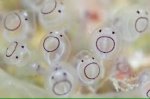

(via ✿_マリコさんのツイート: “#秘密にしておきたかった生き物 ホヤの子供。カールおじさんホヤって愛唱で呼ばれてるけどかわいいと思う https://t.co/RxCXlTwIph”)
:O :O :O :O :O
These are tunicates and the rings really are their mouths but I don’t know what the dots are for!
 EY FATTY BOOM BOOM