currentsinbiology:

The Strange History Of The Spleen, The Organ That Can Replicate Itself

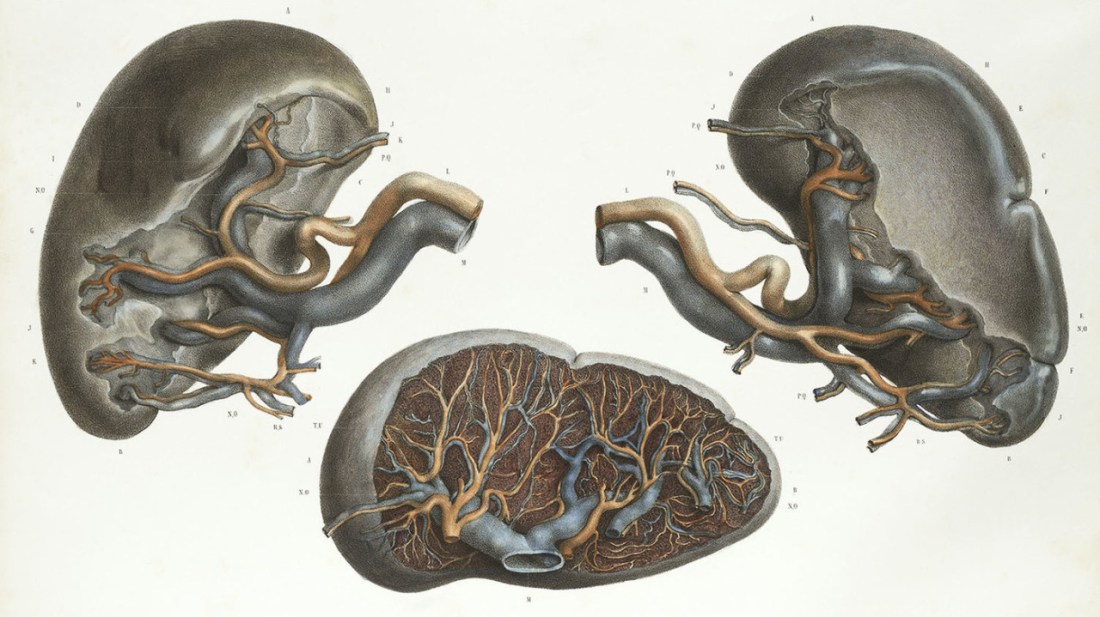
We know that while you’re still a fetus, the spleen makes red blood
cells. And as an adult, the spleen acts as a garbage can, filtering out
damaged blood cells and platelets. But you can live with some old broken
blood cells, so if you injured your spleen in the 1950s, doctors
wouldn’t waste time trying to stitch it up. They’d cut it out in a
splenectomy and send you on your way.

But modern imaging
technology has left us with a different picture of the spleen, realizing
that it has a role in the immune system. Blood slows down as it passes
through the spleen, which gives the immune system time to recognize and
make antibodies for certain types of bacteria.

When a spleen is injured, cells from the organ scatter throughout the
abdomen. If the cells are lucky enough to land somewhere with a lot of
blood vessels, they start to grow into tiny extra spleens called
splenunculi. The whole process is called splenosis, and it seems to be
pretty common: about 1 in 5 people have accessory spleens.

currentsinbiology:

Orgasm is all about rhythmic timing, according to new research paper

“Synchronization is important for signal propagation in the brain,
because neurons are more likely to fire if they are stimulated multiple
times within a narrow window of time,” Safron said. “Otherwise, the
signals decay as part of a general resetting mechanism, rather than sum
together. This then caused me to hypothesize that rhythmic entrainment
is the primary mechanism by which orgasmic thresholds are surpassed.”

Safron said this research could be relevant for improving sexual
functioning, encouraging people to focus more on the rhythmic aspects of
sexuality.

“The idea that sexual experiences can be like trance states is in
some ways ancient. Turns out this idea is supported by modern
understandings of neuroscience,” Safron said. “In theory, this could
change the way people view their sexuality. Sex is a source of
pleasurable sensations and emotional connection, but beyond that, it’s
actually an altered state of consciousness.”

Safron found parallels between sexual climax and seizures as well as with music and dance—something he wasn’t expecting.

In both orgasm and reflex seizures, rhythmic inputs into
high-bandwidth sensory channels resulted in an explosive process after
certain stimulation thresholds were surpassed.

“And although obvious in retrospect, I wasn’t expecting to find that
sexual activity was so similar to music and dance, not just in the
nature of the experiences, but also in that evolutionarily,
rhythm-keeping ability may serve as a test of fitness for potential
mates.”

He said this is consistent with the fact that rhythmic song and
dances are nearly universal parts of mating, going back hundreds of
millions of years to our common ancestors with pre-vertebrate animals
such as insects.

The article appeared in the journal Socioaffective Neuroscience and Psychology’s special issue “Orgasm: Neurophysiological, Psychological, and Evolutionary Perspectives.”
                                       

The Thirsty Little Snake That Swam Across the World

snailchimera:

madsciences:

followthebluebell:

the-awkward-turt:

thlpp:

The 62 species of sea snakes are all wonderfully adapted to life in the oceans, but they almost always come ashore to lay eggs. But not the yellow-bellied one; it is the only member of the group that lives full-time in the open ocean. It eats at sea, mates at sea, and gives birth to live young at sea. It has special valves in its nose to stop water from getting in, and can even partially breathe through its skin. It hunts by sitting amid flotsam and picking off small fish that gather beneath it. And it swims by propelling itself with a flattened, paddle-like tail.

And yet, in some ways, it is so ill-suited to life in the ocean that its existence borders on poetic tragedy. For example, a few years ago, Brischoux and his colleague Harvey Lillywhite from the University of Florida showed that the yellow-bellied sea snake is almost constantly thirsty and dehydrated.

If you tried to swallow water in the ocean, your kidneys would remove the extra salt by diluting it in urine. In doing so, you’d actually get rid of more water than you ingested. This is why, when humans drink seawater, they get dehydrated. Some marine animals cope with this problem using special salt-removing glands, but Lillywhite showed that—contrary to what scientists previously believed—sea snakes do not. They live most of their lives in the oceans, but they never swallow seawater. Instead, they try quench their thirst with fresh water.

Some species stick close to coastal sites with nearby sources of fresh water, like springs or streams that empty into the sea. But the yellow-bellied sea snake has no such option. Instead, it drinks from the thin layers of freshwater that briefly form on the surface of the ocean when it rains. That seems precarious, and it is. For much of the year, from November to May, these snakes are almost constantly dehydrated.

The yellow-bellied sea snake isn’t a great swimmer either. “It is really small,” says Brischoux. “It can move in the water, but not for a very long period of time and not against really strong currents—unlike, say, a seal.” So how could it possibly occupy such a large range? The only other tetrapods that are so widespread are either powerful swimmers like the giant whales or strong fliers like seabirds. The yellow-bellied sea snake is neither, and yet it has spread over two-thirds of the Earth’s surface.

Read full article here.

I support this small, weak-swimming, constantly dehydrated snake.
finally found my patronus: an animal as poorly adapted to life as I am.

alright who’s willing to swim out and give them gatorades we need volunteers

The Thirsty Little Snake That Swam Across the World