What advice to you give other women in science? Haley got the chance to visit the California Academy of Sciences for the #SciWomen16 Summit. Here is what the women there had to say.
Here are the women in order of appearance:
Haley Chamberlain Nelson
Emily Graslie
Perrin Ireland
Meg Lowman
Ann Russel
Heather Tallis
Sylvia Earle
Michelle Trautwein
Megan Wilkinson
Misha Leong
Kathy Sullivan
Carla Sette
Liz Taylor
Shannon Bennet
Anika Kapan
Annika Min
Shaila Kotadia
Justine Hausheer
Joan Roughgarden
Rita Mehta
Karina Chavarria
Madeline Foster-Martinez
Andrew Collins
Tracy Gatumu
Jane Goodall
I was reviewing wound healing by watching youtube lectures on it and I stumbled across this video of fibroblasts doing their thaaaang. Cool beans. I love it! I’ve never seen these things in action before!
So, in a very big nutshell, if you’re not sure what fibroblasts are, they build collagen fibers. Collagen fibers are incredibly strong connective fibers that hold things together. So when you cut yourself, a lot of things happen to repair it as quickly and efficiently as possible – fibroblasts rushing to the scene to build a new matrix to help repair the damaged tissue is one of those things. They also help pull the wound together, making it easier for the cells to grow back together.
The epidemic began on September 13, 2005, when Blizzard introduced a new raid called Zul’Gurub into the game as part of a new update. Its end boss, Hakkar, could affect players by using a debuff called Corrupted Blood, a disease that damages players over time, this one specifically doing significant damage. The disease could be passed on between any nearby characters, and would kill characters with lower levels in a few seconds, while higher level characters could keep themselves alive. It would disappear as time passed or when the character died. Due to a programming error, players’ pets and minions carried the disease out of the raid.
Non-player characters could contract the disease but were asymptomatic to it and could spread it to others.[2] At least three of the game’s servers were affected. The difficulty in killing Hakkar may have limited the spread of the disease. Discussion forum posters described seeing hundreds of bodies lying in the streets of the towns and cities. Deaths in World of Warcraft are not permanent, as characters are resurrected shortly afterward.[3] However, dying in such a way is disadvantageous to the player’s character and incurs inconvenience.[4]
During the epidemic, normal gameplay was disrupted. Player responses varied but resembled real-world behaviors. Some characters with healing abilities volunteered their services, some lower-level characters who could not help would direct people away from infected areas, some characters would flee to uninfected areas, and some characters attempted to spread the disease to others.[2] Players in the game reacted to the disease as if there was real risk to their well-being.[5] Blizzard Entertainment attempted to institute a voluntary quarantine to stem the disease, but it failed, as some players didn’t take it seriously, while others took advantage of the pandemonium.[2] Despite certain security measures, players overcame them by giving the disease to summonable pets.[6] Blizzard was forced to fix the problem by instituting hard resets of the servers and applying quick fixes.[3]
The major towns and cities were abandoned by the population as panic set in and players rushed to evacuate to the relative safety of the countryside, leaving urban areas filled to the brim with corpses, and the city streets literally white with the bones of the dead.[7]
So for 20 years of this epidemic, researchers focusing on genes instead of things that may be messing up the genes (epigenetic factors) have discovered this! Fucking brilliant! And we now still know nothing because why???
New light has
been shed on the genetic relationship between autistic spectrum
disorders (ASD) and ASD-related traits in the wider population, by a
team of international researchers including academics from the
University of Bristol, the Broad Institute of Harvard and MIT, and
Massachusetts General Hospital (MGH).
The researchers studied whether there is a genetic relationship
between ASD and the expression of ASD-related traits in populations not
considered to have ASD. Their findings, published this week in Nature Genetics,
suggest that genetic risk underlying ASD, including both inherited
variants and de novo influences (not seen in an individual’s parents),
affects a range of behavioural and developmental traits across the
population, with those diagnosed with ASD representing a severe
presentation of those traits.
“Genetic risk for autism
spectrum disorders and neuropsychiatric variation in the general
population” by Robinson, EB, St. Pourcain, B et al. will appear in Nature Genetics during the week of March 21 2016.
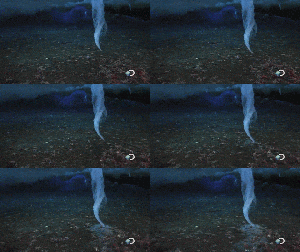
A brinicle, also commonly known as an “ice stalactite” forms under the sea ice when a flow of extremely cold saline water is introduced to ocean water. It is known as an ice stalactite because it is the undersea equivalent of a hollow stalactite. It freezes everything it touches, including sea creatures.
Tis real! But it looks like a CGI curse from a 90s film.
Carefully arranged within thousands of drawers, flat files, and shelving units are the collections of the National Museum of Natural History
(NMNH) which together comprise 90% of the Smithsonian’s collections.
Found in these material assortments are the reference objects that help
scientists, researchers, and museum curators understand our planet—from
solid earth fragments to biological material and cultural objects from
civilizations long diseased.