Switching on silent
genesFor a while now scientists have been excited by a
gene-editing tool called CRISPR/Cas9 which allows us to very precisely add,
remove or replace specific parts of DNA.It’s the most efficient, inexpensive and easiest-to-use
gene-editing tool we have ever seen, but until now one thing it hasn’t been
used for is activating switched-off genes.However scientists at Hokkaido University’s Institute of
Genetic Medicine have developed a way to do just that.Our genes are controlled by switches called promoters. When
a promoter switch is ‘methylated’ – a carbon atom and three hydrogen atoms bind
to it – then it is switched off, or silenced.To switch a silenced gene back on, first they used CRISPR/Cas9
to cut out the methylated promoter. Then the researchers used a technique called MMEJ
(microhomology-mediated end-joining), to insert a new promoter, replacing
the off-switch with an on-switch.The scientists tested the tool on two genes and found evidence
that both were switched on and working robustly once the promoter was swapped. It worked
so well that one of the expressed genes made the cell differentiate from a stem
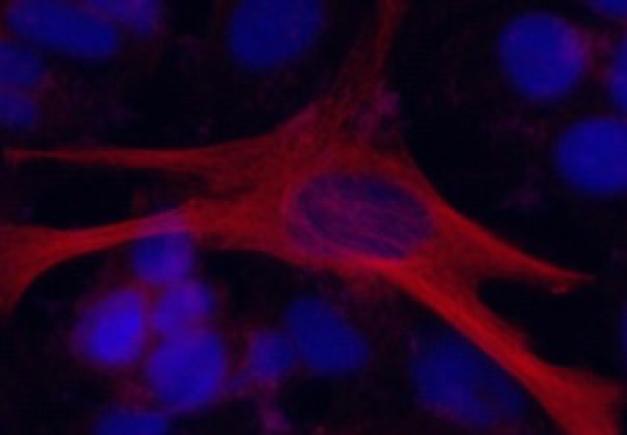
cell to a neuron in a week.In the picture above, you can see human stem cells expressing protein from the activated gene, in red. Cell nuclei are coloured blue.
The team believe their tool has wide potential for
manipulating gene expression, creating genetic circuits, or engineering cell
fates.
Image: Hokkaido University
Switching genes off and on with CRISPR – oh the possibilities!

 EY FATTY BOOM BOOM