Scientists discover how the brain re-purposes itself to learn scientific concepts
The human brain was initially used for basic
survival tasks, such as staying safe and hunting and gathering. Yet,
200,000 years later, the same human brain is able to learn abstract
concepts, like momentum, energy and gravity, which have only been
formally defined in the last few centuries.New research from Carnegie Mellon University has now uncovered how
the brain is able to acquire brand new types of ideas. Published in Psychological Science,
scientists Robert Mason and Marcel Just used neural-decoding techniques
developed at CMU to identify specific physics concepts that advanced
students recalled when prompted. The brain activation patterns while
thinking about the physics concepts indicated that all of the students’
brains used the ancient brain systems the same way, and the patterns
revealed how the new knowledge was formed – by re-purposing existing
neural systems.The findings could be used to improve science instruction.
“If science teachers know how the brain is going to encode a new
science concept, then they can define and elaborate that concept in ways
that match the encoding. They can teach to the brain by using the
brain’s language,” said Mason, a senior research associate in the
Dietrich College of Humanities and Social Sciences’ Department of
Psychology.Read the full study: http://www.ccbi.cmu.edu/reprints/Mason_Psychological-Science-2016_CCBI-preprint.pdf
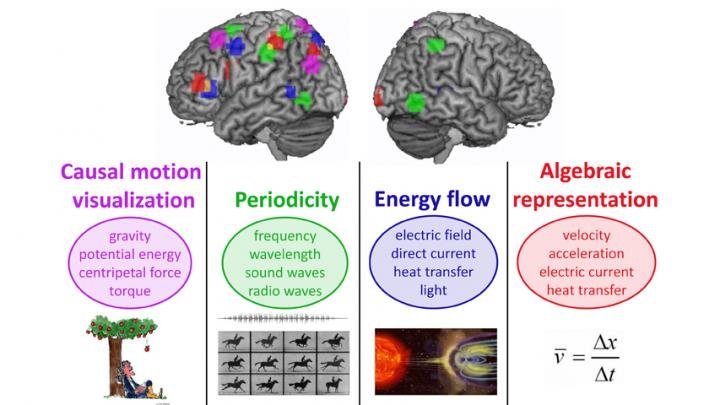
New research from Carnegie Mellon University
shows for the first time how learning physics concepts is accomplished
by repurposing neural structures that were originally used for general
everyday purposes. More specifically, the brain is able to learn physics
concepts because of its ability to understand the four fundamental
concepts of causal motion, periodicity, energy flow and algebraic
(sentence-like) representations. Credit: Carnegie Mellon University

 EY FATTY BOOM BOOM